Get Full Government Meeting Transcripts, Videos, & Alerts Forever!
Get email alerts on the Solid Waste And Recycling topic
No spam. Unsubscribe anytime.
Committee adopts subscription model for yard‑waste collection; $50 opt‑in fee and gap year contingency
Summary
The committee approved a hybrid yard‑waste program that offers two free curbside collections for all residents and an opt‑in subscription for biweekly service, with staff to set the annual subscription fee and use contingency funds to cover a 2026 gap while the program is implemented for 2027.
The Financial Affairs Committee voted to change the yard‑waste collection program beginning in 2027, adopting a hybrid subscription model that provides two free curbside collections for all residents and an opt‑in subscription for homeowners who want biweekly curbside service.
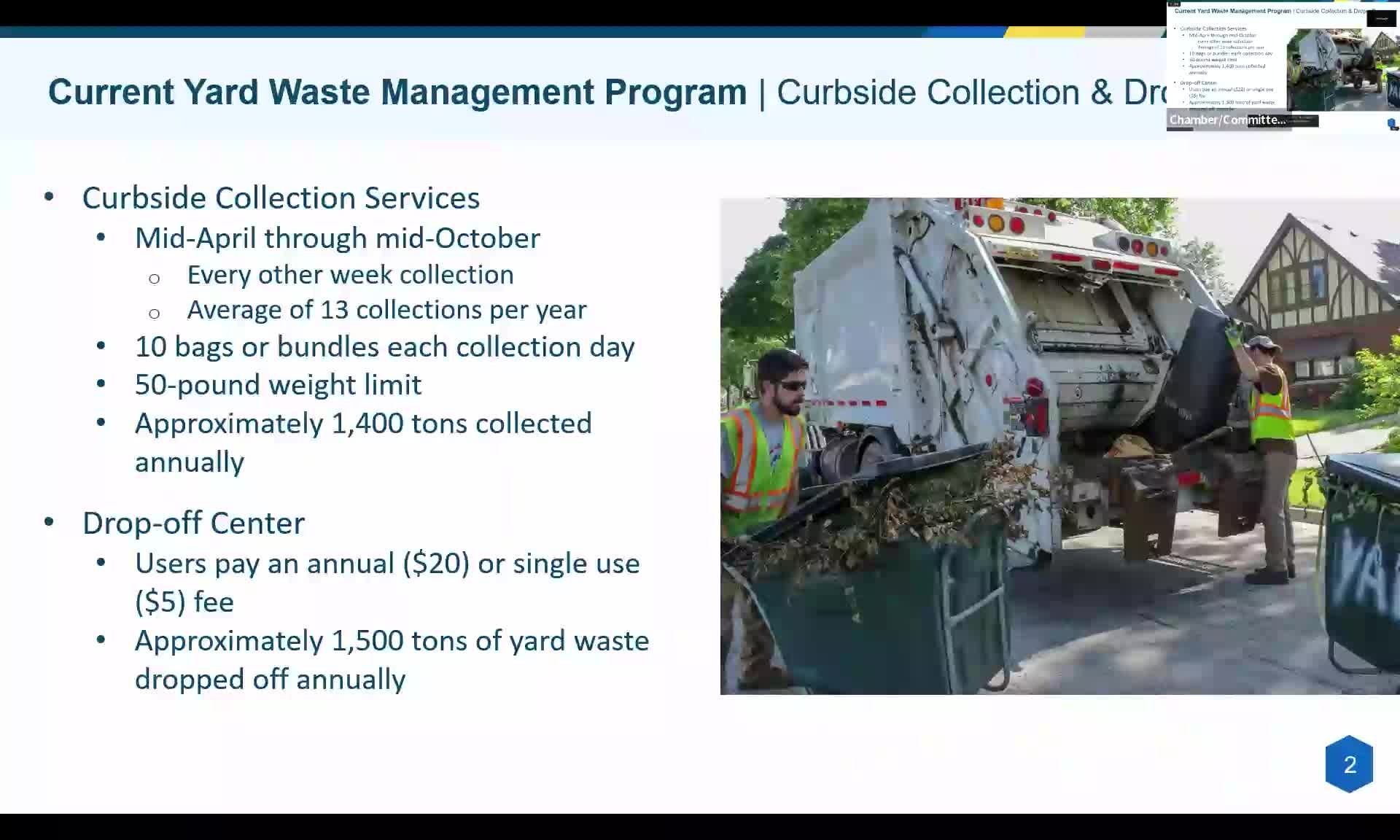
Director Simpson presented options developed after earlier committee direction. The chosen model (described to the committee as a modified subscription) will: (a) offer two free curbside yard‑waste pickups (spring and mid‑summer) for all residents; (b) provide an optional subscription that supplies a 96‑gallon cart and biweekly curbside service (eight collections per subscription year) for a recurring annual fee; (c) keep the city drop‑off facility free to residents; and (d) permit subscribers to place up to five additional bags/bundles at curb alongside the cart on collection days.
Staff explained that proceeds from subscriptions would finance truck replacements and begin to establish a replacement reserve; staff modeled a range of subscription counts, indicating a likely per‑household annual fee in the $50 range if several thousand households opt in. The committee discussed alternatives including a one‑time cart purchase model and a reduced season model; several members stressed the need to protect staff from heavy lifting and cited worker‑injury concerns as a driver of the policy change toward carts and mechanical lifting.
Alder Phillips moved to adopt the subscription model (option 3) with the direction that staff set an annual subscription fee (committee discussed $50 as a practical flat figure) and that the 2026 shortfall/gap year be covered from contingency/reserves while staff implements the subscription program for a 2027 start. Alder Gustafson seconded. The motion passed 6 to 1 (Alder Morgan recorded as opposed).
Staff noted implementation would require resident outreach, an administrative signup system and a lead time for cart procurement and route optimization; staff estimated the subscription program could be implemented in 2027 and that the committee would receive further implementation details, fee schedules and operational timelines before launch. The committee also discussed alternative temporary funding sources for 2026, including vehicle registration fee mechanisms and other operating line transfers. Several members asked staff to return with detailed subscription fee modeling and an outreach plan.