
Sedona commission approves Trailhead Shuttle lot expansion with conditions to protect neighborhood
Get AI-powered insights, summaries, and transcripts
Subscribe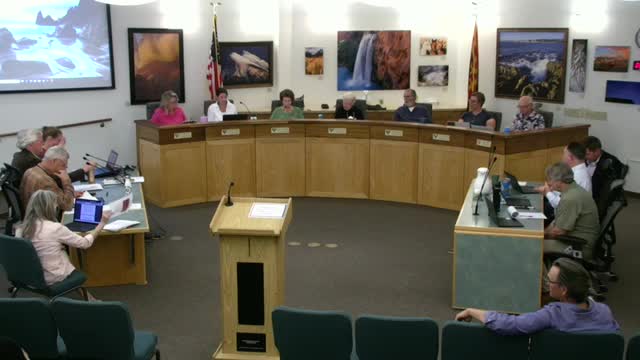
Summary
The Planning & Zoning Commission on Oct. 21 approved a conditional use permit amendment (PC2400009) to expand the Trailhead Shuttle park‑and‑ride on State Route 179, 7-0, adding capacity and a dedicated shuttle lane while imposing design and mitigation conditions requested by neighbors and commissioners.
The Sedona Planning & Zoning Commission unanimously approved a conditional use permit amendment on Oct. 21 to expand and reconfigure the Trailhead Shuttle park‑and‑ride lot at 1294 and 1406 State Route 179 (case PC2400009). The approval, 7‑0, included conditions the commission added during the hearing to reduce visual and noise impacts on adjacent neighborhoods and to require a post‑construction review of operations.
What the commission approved
The amendment allows expansion of the existing lot (the subject parcel is roughly 1.94 acres) and circulation changes intended to separate shuttle operations from vehicle and pedestrian flows. Key elements approved include a dedicated shuttle slip lane so buses can load and depart without entering the car parking aisles, a reworked vehicle turnaround to reduce spillover traffic into nearby residential streets, installation of a shade pavilion and restroom facility, and enhanced pedestrian sidewalks linking to the shared‑use path on SR‑179.
Why it matters: safety, service and neighborhood impacts
Public works and transit staff said the redesign addresses safety and operational problems at the current lot, where cars, buses and pedestrians share the same paved surface. "We have 3 modes of transportation we're trying to serve in 1 parking lot — cars, shuttle buses, and pedestrians — and right now they're all using the exact same pavement," John Hall, the city engineering supervisor, said at the hearing. Staff said the change will reduce circulation and idling that now spill into neighboring streets, and will improve transit reliability.
Ridership and operations
Amber Wagner, Sedona’s transit administrator, said the transit program has matured rapidly: in its first year the city’s newer services generated thousands of passenger trips, and the trailhead lot has been one of the system’s busiest nodes. "In just the first year of our operations it has provided over 7,900 trips... We've had over 16,000 passengers, and 1,200 of those 7,900 trips were to this site," Wagner said. City staff said improved management and better information (real‑time occupancy signage and apps) will be paired with the physical improvements.
Neighborhood concerns and mitigation
Residents who live near the lot said the lot already produces noise, traffic and walk‑throughs into the neighborhood, and urged the commission to limit any expansion that would push pavement close to the highway and reduce tree screening. Commission members and staff responded by drafting conditions at the hearing: among them were reducing several parking stalls on the south edge of the lot so as to retain existing mature trees and vegetation where possible; exploring decomposed‑granite or other less‑permanent surfaces in portions of the turnaround to reduce visual impact; enhancing the planting plan with native screening and, if needed, a low barrier (native hedging or a rusted‑steel fence) to block direct sightlines from the highway into parked vehicles; and requiring a planning‑commission review of operations 24 months after completion.
Technical and design details
Staff and consultants said the proposal reconciles safety and circulation issues by adding a slip lane for shuttles, a designated passenger alighting area with shade and restrooms, and sidewalks linking to the shared use path and the Church of the Red Rocks crossing. ADOT review of the revised frontage improvements and an existing ADOT encroachment permit were discussed; staff said ADOT had already been engaged and the design responds to their requirements for a bus pullout on the highway.
Vote and conditions
The commission voted 7‑0 to approve the CUP amendment; the motion as read on the record adopted the staff report findings and added the conditions described above (reduction of selected south‑side parking stalls, use of decomposed granite or similar material in the turnaround area, revised landscape/vegetation plan emphasizing native evergreen screening and irrigation for establishment, additional pedestrian signage and textured crossing surfacing at the slip‑lane crossing, and a 24‑month post‑construction review of operations by the commission). The commission instructed staff to return final drawings showing the changes and commit to the screening and post‑construction review before final construction permits are issued.
Ending note
Commissioners and staff framed the project as a step toward stabilizing a chronically congested park‑and‑ride node while seeking to protect neighborhood character. Neighbors asked for—and won—greater attention to tree preservation, sightline mitigation and a commitment to monitor operations after construction. The project is budgeted for the current fiscal year; staff said construction scheduling will follow design refinement and final permit approvals.