Get Full Government Meeting Transcripts, Videos, & Alerts Forever!
Get email alerts on the Tobacco Retail Licensing topic
No spam. Unsubscribe anytime.
National City Council rescinds, then reintroduces tobacco retail licensing ordinance after weeks of public debate
Summary
The National City City Council rescinded a recently adopted tobacco retail licensing ordinance because of a technical notice defect, then reintroduced the same measure with changes after an extended public hearing that split health advocates and neighborhood retailers.
The National City City Council rescinded a tobacco retail licensing ordinance it had adopted at a prior meeting and reintroduced the same ordinance for first reading Tuesday, following a legal notice issue and an extended public hearing that drew dozens of speakers for and against the measure.
Councilmembers said the step was intended to avoid litigation after the city attorney’s office found a “technical notice defect” in the earlier process and to allow the council to fix language before proceeding to adoption. The ordinance would amend Title 9, chapter 9.38, of the National City Municipal Code to establish a local tobacco retail license program, add annual inspections and create penalties for illegal sales to minors and other violations.
The public hearing drew more than 50 speakers and numerous written comments. Health advocates, school and public-health officials and family members urged the council to keep proximity limits around schools, annual compliance checks and suspension or revocation penalties in place. Business groups representing neighborhood markets, fuel and convenience stores urged changes that would allow buyers to obtain a tobacco retail license when they purchase an existing business and asked the council to remove or narrow 1,000-foot buffers around schools and youth facilities.
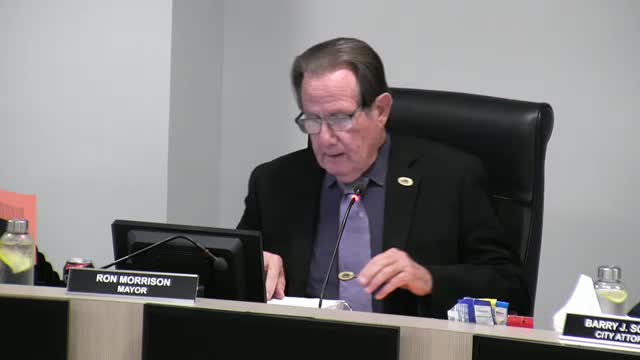
City Attorney Barry Schultz told the council a letter from the Neighborhood Market Association raised a valid procedural concern about the prior meeting’s notice and that the city should rescind and reintroduce the ordinance to avoid unnecessary litigation. The council voted to rescind the earlier ordinance by roll call (Yamani: Aye; Molina: Yes; Vice Mayor Bush: Yes; Mayor Morrison: Aye).
After the public hearing, Councilmember Molina moved to reintroduce the ordinance with changes proposed by market representatives on transferability and with adjusted enforcement language; a colleague seconded. The council voted to reintroduce the ordinance for first reading with those amendments (vote by roll call: Yamani Aye; Rodriguez Aye; Molina Yes; Vice Mayor Bush Yes; Mayor Morrison Aye).
What would change: The council directed staff to bring back language that (a) clarifies that existing, grandfathered retail locations remain eligible for a license even if they fall within the distance buffers; (b) revises the ordinance’s transferability language so that a license tied to a location may be transferred on a change of proprietor at that location (subject to conditions); and (c) adjusts the violation-and-penalty schedule to the version negotiated with market representatives while preserving suspension/revocation authority for illegal sales to minors. The reintroduction motion also asked staff to preserve a clear path for enforcement focusing on illegal sales as the primary trigger for license suspension or revocation.
Health and youth advocates pressed the council to keep strong penalties and a longer “look‑back” period for prior violations so repeat offenders cannot evade enforcement by selling a business. Emily Miller of the American Heart Association said routine inspections “are critical to preventing underage access to tobacco” and urged a penalty at first violation that would strengthen retailer compliance. Community speakers described underage vaping and other youth access concerns; several described being able to buy high‑potency vape products as teenagers.
Retail and industry speakers said the draft ordinance as introduced would strip value from long‑time small businesses. Jim Madaffer and other market association representatives asked the council to allow an owner to complete an arm’s‑length sale without losing the ability of the buyer to qualify for a license at the existing location, and proposed higher monetary fines in place of some suspensions as a way to fund inspections.
Next steps: Council members asked city staff and the city attorney to prepare ordinance language that implements the reintroduction motion, clarifies enforcement triggers, and provides precise administrative processes for license issuance, renewal and appeals. The reintroduced ordinance will return for a second reading and possible adoption on the council’s regular schedule; staff told the council they will bring back a redline of the exact ordinance text for the next meeting.
The council’s decision to rescind and reintroduce the ordinance was procedural; it did not eliminate the underlying policy effort to establish a local tobacco retail license program. The debate made clear the council faces a choice between stronger proximity and suspension rules favored by health advocates and compromises on transferability and penalty structure sought by many small retailers.