Get AI Briefings, Transcripts & Alerts on Local & National Government Meetings — Forever.
Council denies 7‑Eleven special‑use permit for fuel station at Hardin and FM 543 after neighbors cite safety, buffer concerns
Loading...
Summary
The council unanimously denied a special‑use permit for a proposed 7‑Eleven with fueling islands near the Honey Creek neighborhood, citing insufficient setback between fuel dispensers and nearby single‑family homes and safety/quality‑of‑life concerns from nearby homeowners.
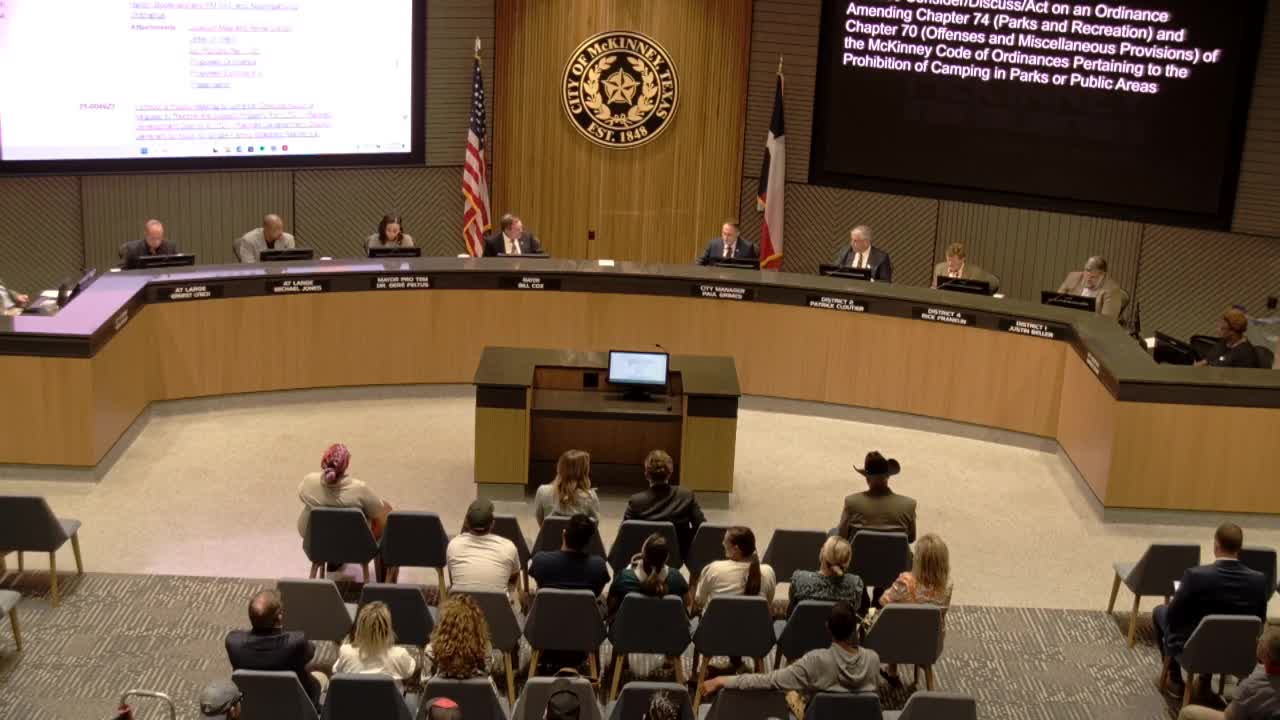
The McKinney City Council voted unanimously Oct. 21 to deny a special‑use permit for a proposed 7‑Eleven convenience store and fuel station at the northeast corner of Hardin Boulevard and FM 543, citing spacing, safety and neighborhood impacts.
Planning staff recommended denial because the closest fueling islands would be about 188 feet from adjacent single‑family rear property lines, short of the city’s stated 250‑foot separation for fuel dispensers and residential lots. Lucas Raley, director of planning, told council that the planning and zoning commission had recommended the use with stipulations — a solid masonry wall along the north property line and vegetative screening to the east — but that staff’s recommendation remained denial due to the proximity and related public‑safety concerns.
Applicant Brad White said the site could not push the pumps farther south because of a water easement and that the fuel‑dispensing islands would be about 188 feet from the adjacent backyards. White described an elevated masonry building and a larger convenience‑store prototype that he said would serve a growing area; he told council “we're doing everything we can to ensure that we're bringing a nice building to the community.”
Multiple nearby homeowners spoke in opposition during the public hearing, citing fumes, bright lighting, late‑night activity, truck traffic and the proximity of an underground 12,000‑gallon fuel tank. One resident said when he paced the site he found the underground tank to be roughly 130 feet from his property and said, “12,000 gallons of fuel — that scares the life out of me.” A nearby urban planner who lives in the Preserve at Honey Creek said a gas station is “one of the most intensive commercial uses you can introduce into a neighborhood” and argued that the city’s 250‑foot buffer exists to reduce noise, fumes and safety risks.
Council members noted the applicant’s right to seek land use approvals but said the location was not a good fit for single‑family adjacency. One council member said the corner will be developed in time, but rejected this design; others said the spacing and health concerns supported denial.
Councilman Cloutier moved to deny the SUP; Councilman Franklin seconded. The motion passed 7–0.
Planning and zoning had previously approved the permit with stipulations, and staff said that if council had chosen to approve the SUP it would have asked for specific language for those stipulations. The denial preserves the 250‑foot buffer standard as the planning staff interprets it and leaves the vacant corner available for other uses or future proposals that meet setback and safety requirements.