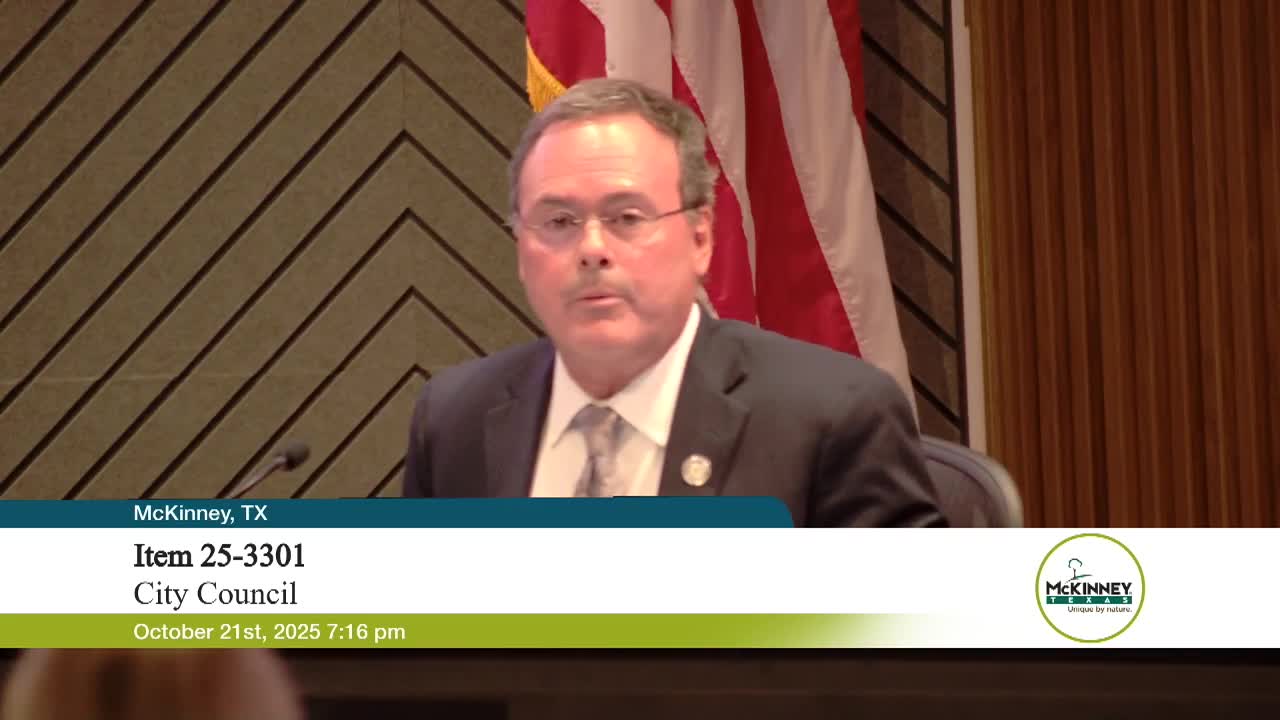
McKinney council adopts ‘Better Together’ initiative and two ordinances restricting public sleeping, camping
Loading...
Summary
The McKinney City Council on Oct. 21 approved a resolution supporting the Better Together homelessness initiative and passed two ordinances that restrict sleeping in downtown public spaces and camping in public areas and city lots; both ordinances include one‑year sunset clauses and drew lengthy public comment and divided council votes.
The McKinney City Council voted Oct. 21 to adopt a resolution backing the city’s Better Together homelessness initiative and approved two related ordinance amendments that restrict sleeping in downtown public spaces and camping in public areas and on certain city lots.
The council approved the resolution supporting the Better Together guiding principles, then passed an amendment to Chapter 70 to create a downtown-only “physical occupancy” prohibition and a separate amendment moving and expanding the city’s camping prohibition. The downtown physical-occupancy ordinance passed 6–1; the citywide camping ordinance, which adds prohibitions on sleeping in vehicles on city lots and rights of way and places limited responsibility on private property owners who knowingly allow camping, passed 5–2. Each ordinance includes an initial one‑year sunset clause so the council can review enforcement and outcomes.
Supporters of the Better Together initiative and members of the homeless-services community urged investment in caseworkers and coordinated outreach rather than criminal penalties. Lee Stark, the street outreach caseworker for the wellness center for older adults, told council that outreach since May 2023 had recorded 424 unique people encountered in McKinney and that two caseworkers had helped house 47 people; he and others advocated for adding five caseworkers under the Better Together plan. Stark said, “Think of what we will be able to do with the Better Together program with 5 caseworkers. I really think that we will be able to dramatically impact the homelessness situation within McKinney.”
Many members of the public, including residents and nonprofit providers, opposed the camping and physical-occupancy ordinances. Molly Brown, who identified herself as a resident, called the proposals “punish[ing] being poor” and warned they would “kill people needlessly” by criminalizing visible homelessness. She cited national trends and surveys to argue that criminalization displaces people without reducing homelessness and urged the council to pursue housing-first and zoning reforms instead.
Other speakers described operational burdens that new ordinances would place on nonprofit shelters and hospitals. Heather Malsby, who identified herself with local shelter work, said shelters and outreach groups already provide services but lack funding and that additional enforcement would “add yet another undue and unfunded burden and mandate to our police, jail system, and hospitals.” Several speakers urged the council to prioritize coordinated services and funding over criminal enforcement.
Council and staff described the ordinances as “tools in the toolbox” meant to address safety and quality‑of‑life issues in downtown areas while preserving avenues for shelter and private accommodations. City staff clarified legal scope and carve-outs during the meeting: the physical-occupancy ordinance applies only within the MTC downtown zoning district and covers public streets, sidewalks, medians, parkways and pedestrian rights of way; it does not criminalize use of benches or park seating designed for sitting or events in parks. The camping ordinance will be citywide but specifically allows camping on private property and in designated parks and allows overnight sleeping in commercial private parking lots; sleeping in vehicles would be prohibited only on city-owned parking lots and public rights of way. Staff and council repeatedly noted that private homes are not covered if the person is brought inside or kept off the publicly accessible portion of the property.
Police and legal staff described enforcement options and potential workarounds. Lieutenant Kennedy of the McKinney Police Department said the department is exploring a “CTW affidavit” program used by other cities that would let property owners file an affidavit authorizing police action without being present. City Attorney Jeremy Page said the ordinances were written to limit municipal reach to the defined areas and to preserve criminal trespass and other existing remedies for private-property situations.
Council members were divided on whether the ordinances would create enforceable, equitable outcomes. Supporters said the measures protect downtown businesses and residents and give police a legal mechanism to address public-safety behavior. Opponents, including one council member who voted against the downtown physical-occupancy ordinance and another who opposed the citywide camping ordinance, said the city is acting without adequate housing alternatives and would risk displacing people without offering solutions. One council member called the proposals a “tool in the tool belt” but acknowledged the political and practical sensitivities and emphasized the one‑year review.
The council’s votes were: approval of the Better Together resolution (motion and second recorded; item passed), approval of the downtown physical-occupancy ordinance (vote 6–1), and approval of the camping ordinance that expands the definition of camping to include sleeping in a vehicle overnight in some public places and places limited responsibility on property owners (vote 5–2). Staff and several council members said enforcement would be incremental and monitored under the one‑year sunset clauses. The council asked staff to return sooner if problems emerge and police to report back on any enforcement tools such as affidavits.
City officials and nonprofit leaders said they intend to continue coordinated outreach, build provider partnerships and evaluate whether the new rules create unintended harm. As Jennifer Arnold, the city manager, told the council, “This is one of those tools again that we see that may be beneficial as we're trying to address certain behaviors in and around downtown. But we definitely recognize that it's one that needs to be monitored closely.”
The council meeting record shows extended public comment and multiple staff clarifications; the council also instructed staff to continue working with nonprofit partners and to report on enforcement and any needed adjustments during the ordinance sunset period.