Get Full Government Meeting Transcripts, Videos, & Alerts Forever!
Get email alerts on the Open Government Ethics topic
No spam. Unsubscribe anytime.
Commissioners review open‑government rules, conflicts of interest and meeting protocols
Summary
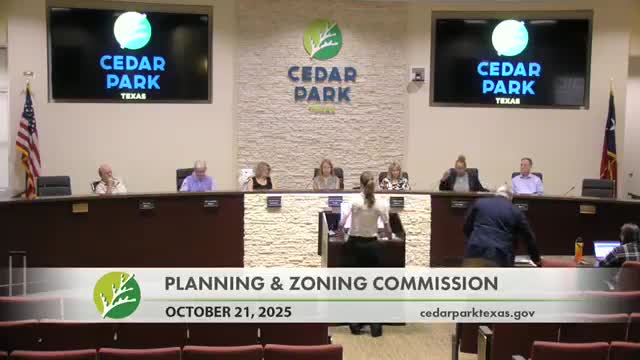
Senior Assistant City Attorney Jill Hoffman briefed the Cedar Park Planning and Zoning Commission on the Texas Public Information Act, Open Meetings Act, conflict‑of‑interest thresholds and local rules that limit ex parte contacts and meetings with applicants.
Cedar Park, Texas — Senior Assistant City Attorney Jill Hoffman on Oct. 21 reviewed open‑government laws, ethics rules and the planning commission’s formal authorities with the Cedar Park Planning and Zoning Commission, emphasizing transparency, limits on out‑of‑meeting contacts and the commission’s distinct roles on plats and zoning recommendations.
Hoffman told commissioners that both the Texas Public Information Act and the Open Meetings Act aim to make commission business available to the public and that records and deliberations are subject to disclosure regardless of the device on which they are stored. “It is what the information is,” she said, “so if you have it on a personal device… it is subject to the Public Information Act.”
She described the Open Meetings Act definition of a meeting as “a deliberation between a quorum of the commission involving discussion of public business” and warned that informal conversations, e‑mail or text messages among enough commissioners can create an unlawful “walking quorum.” “It happens a lot easier than you might think,” Hoffman said, urging caution after meetings and in one‑on‑one contact among members.
Hoffman reviewed conflict‑of‑interest rules in Chapter 171 of the Texas Local Government Code and local thresholds commissioners must follow. She said a “substantial interest” in a business entity is generally ownership of 10 percent or an interest valued at $15,000; for real property the ownership threshold she cited was $2,500. Commissioners must file an affidavit and abstain when those thresholds apply, she said. “If you ever have any questions, you can always call me to talk through those issues,” Hoffman added.
She also summarized relevant criminal prohibitions in the Texas Penal Code, citing sections prohibiting receipt of bribes, misuse of official property and misuse of official information — examples she gave ranged from improper use of a city printer for private materials to “insider” use of confidential executive‑session information.
Hoffman pointed to provisions in the Cedar Park rules and charter that bar commissioners from meeting with applicants outside of a posted meeting: “This is different than council… you all may not” meet privately with applicants, she said, and referred commissioners to Rule 3.9 of the rules of procedure.
On decision authority she distinguished subdivision and zoning roles: the commission is the final decision‑maker on plats that meet city code and generally has no discretion to deny code‑compliant plats; by contrast the commission makes recommendations to city council on original zonings and rezonings. She also noted the council voting threshold discussed in staff materials for adopting certain zoning actions.
Commissioners asked clarifying questions during the presentation. Commissioner Intel asked whether the prohibition on deliberation applied to the public‑comment portion of hearings or only to citizen communications not on the agenda; Hoffman replied that the restriction about non‑deliberation applies to citizen communications on non‑agenda topics, and that items posted on the agenda are intended for commission deliberation. Commissioner Antel said he and another commissioner had been approached by a developer in the past; Hoffman recommended telling applicants that contact is not allowed and, if necessary, to “hide behind” the rules of procedure when declining private meetings.
The briefing concluded with Hoffman reminding commissioners that the chair has limited discretion to extend speakers’ time during public hearings and that the commission should use the public hearing process to “flush out” information relevant to cases.
The commission did not take formal action on these topics; the session moved next to administrative updates from staff.