Committee identifies signal systems and transit signal priority as a distinct regional focus
Loading...
Summary
Members urged a clearer focus on signal systems and transit signal priority (TSP), citing VDOT control of intersections and the need for cross-jurisdictional coordination to improve transit reliability.
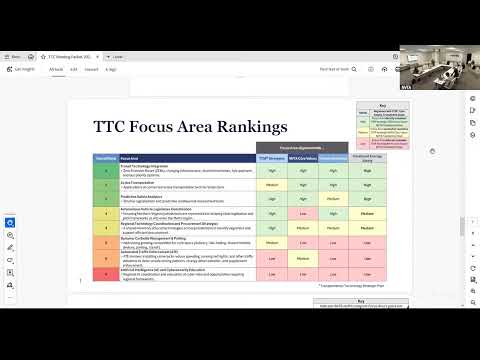
During discussion of the committee—s eight focus areas, several members urged the Transportation Technology Committee to treat roadway signal systems and transit signal priority as a distinct focus because signal policy and control were raised repeatedly as barriers to improved bus performance.
"The number one obstacle to that has nothing to do with any of the transit agencies. It has everything to do with traffic planners," an operator representative, Bob Schneider of OmniRide, said, describing a situation in which traffic signal timing can delay buses through multiple cycles. Schneider said those signal-timing choices are often made to maximize vehicle throughput rather than passenger throughput.
Committee members noted that VDOT maintains significant control over many intersections and that signal managers and technical staff currently operate at different levels across agencies. "VDOT has significant investment and control in those intersections, and they tend to be the larger obstacle," Schneider said. Several members suggested that elected officials or higher-level coordination might be required to change signalization priorities.
Members recommended the committee consider creating or spinning off a focus area specifically for "smarter signalization" that would include TSP, adaptive signal control and consideration of passenger-based metrics (for example, passenger-car-unit equivalents that weigh people rather than just vehicles).
Why it matters: Signal control affects travel times and the reliability of bus-based services including emergent BRT corridors. Several speakers argued that policy and institutional barriers, not just technology, limit deployment of TSP and other signal-based strategies.
Next steps: Staff said it would explore whether an existing VDOT-led regional signals group overlaps with the committee—s potential role and would return a recommendation. NVTA staff and transit agency representatives also agreed to pursue better cross-jurisdictional coordination so that technology investments in signal systems yield interoperable regional benefits.
Ending: The committee asked staff to return options for a possible signalization-focused work item at a future meeting; members emphasized they did not want to duplicate existing technical work but wanted a forum for policy-level coordination and shared lessons learned.