Get Full Government Meeting Transcripts, Videos, & Alerts Forever!
Get email alerts on the Land Use Rv Temporary Permits topic
No spam. Unsubscribe anytime.
Hendry County staff proposes temporary RV permits to allow owner‑builders onsite while homes are built
Summary
Planning director proposed a Land Development Code amendment to allow short‑term RV occupancy for owner‑builders, with initial 90‑day permits, inspection milestones, and storm‑safety and waste‑management conditions.
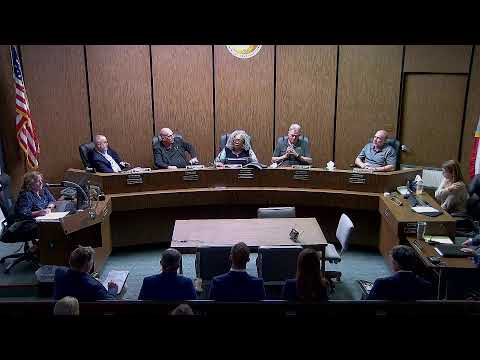
Hendry County planning staff presented a proposed amendment to the Land Development Code (LDC) to permit temporary use of recreational vehicles (RVs) by owner‑builders while constructing a home.
Ryan Alexander, director of planning and community development, told the board the draft framework was modeled on ordinances from other counties and is intended to provide a limited, regulated window for owner‑builders who live on a property while completing construction. Alexander asked the commission for direction on allowable zoning districts and other conditions.
Staff proposed an initial 90‑day temporary use permit. To obtain the permit, an applicant would need an active owner‑builder permit, an approved driveway permit to ensure emergency access, an RV holding tank, and a clearly posted address for 911. Alexander said permit holders could request an inspection within the 90 days; conditional on progress, staff would allow renewals contingent on meet‑the‑milestone items such as an approved power pole, a septic system with a cleanout and connection for the RV, an installed well and an installed driveway. Staff said these checks are intended to ensure construction progress and avoid indefinitely extended RV occupancy.
Commissioners proposed alternatives including size limits on lots (for example, minimum lot sizes to avoid overcrowding), issuing permits in six‑month intervals, or a 12‑month initial permit with required interim check‑ins. Alexander said staff could change the draft to track lot size rather than specific zoning districts and could adjust timing (90 days vs. 6 months) to reflect the board's policy preference. Staff suggested a maximum total occupancy period of 18 months under administrative approvals if a multi‑renewal approach were adopted.
The board discussed sanitation and solid‑waste controls at length. Some commissioners urged a requirement for a trash roll‑off or proof of county dump receipts. Alexander said he had investigated septic and pump‑out service availability in local areas and found some vendors will not provide regular pump‑out service for a single RV; as a short‑term workaround, staff has required permittees to provide documentation from an RV park or dump station that they will use a licensed facility for holding‑tank disposal. Alexander said staff would pursue alternatives such as requiring porta‑john service receipts or proof of dump receipts during the 90‑day period and would follow up with county partners before returning with revised language.
Alexander also said the draft would include a public‑safety provision: temporary RV permits would be suspended during an official named storm declaration and would not be inhabited prior to or during projected landfall in accordance with county emergency management guidance.
Staff emphasized that some details remain under development: trash collection language, enforcement mechanisms for disposal receipts, and any statutory limits on what the county may require from owner‑builders under state building codes. No ordinance amendment was adopted at the meeting; staff will revise the draft and return with proposed LDC language and recommended timeframes for permit durations and renewals.