
Broward officials warn proposed property-tax rollbacks would force deep local cuts as insurance costs climb
Get AI-powered insights, summaries, and transcripts
Subscribe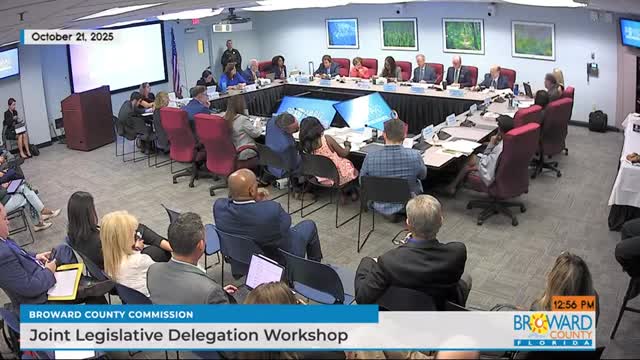
Summary
County commissioners and state lawmakers at a Broward County legislative delegation meeting urged caution about ballot proposals to cut property taxes and stressed that rising property-insurance costs will worsen local budget shortfalls.
Broward County elected officials and state legislators pressed lawmakers about proposals to cut local property taxes and flagged rapidly rising property-insurance costs as a compound threat to county services during a legislative delegation meeting.
County Commissioner and former state legislator Steve Geller urged state lawmakers to treat the numbers used to justify sweeping tax cuts with skepticism, saying the state—FO and governor have relied on inputs he called inaccurate. "85% of our GR comes from property taxes," Geller said, arguing a rollback at the state level would sharply reduce the county's general revenue and make it impossible to preserve current services.
The discussion centered on two linked pressures: proposals circulating in Tallahassee to reduce or restructure property taxes and increases in homeowners—insurance premiums. Commissioners and representatives said those pressures together threaten public safety, emergency services and everyday local programs.
Why it matters: County officials said the proposals under consideration in Orlando would remove a revenue stream that funds sheriff—office contracts, fire rescue, libraries, parks and human services. Several speakers said state fiscal-impact estimates and the governor's public statements mischaracterize local budgets, which depend heavily on property taxes.
Details: Steve Geller and other speakers sought to correct what they described as misleading statewide comparisons. Geller said the governor—s characterization that local governments could eliminate property taxes without hitting law enforcement was incorrect and pointed to budgeting data showing most general-revenue spending supports the sheriff—contract and other public-safety obligations.
Vice Mayor Mark Bogan pressed a related point about the sheriff———s finances, saying the county gives the sheriff—office "over $800,000,000 a year" and argued the public deserves the ability to audit how those funds are spent.
Representative Christine Hunschofsky and others described the multiple parts of a homeowner—s bill to explain that property taxes are only one piece of affordability issues; Hunschofsky noted mortgage principal/interest, insurance and taxes all contribute to housing costs and argued solutions must be broader than a single tax change.
Budget impacts and timing: County staff told the delegation they are already running fiscal-impact analyses of the proposals; county staff reported the least-impactful option under consideration would reduce county revenues by more than $100,000,000. Officials warned that some ballot options could produce larger shortfalls and would force cuts or service changes if implemented without a replacement revenue source.
What officials asked of legislators: Commissioners asked state legislators to narrow any ballot proposals to a single clearly drafted option, to be wary of proposals that would shift costs back to counties and cities, and to consider property-insurance reforms alongside tax-relief proposals so relief to homeowners is not negated by soaring premiums.
Looking ahead: Delegation members said they expect more detailed fiscal-impact materials to be circulated as bills and ballot proposals are refined. County staff said they will continue to compile local cost estimates for specific proposals and share them with the delegation.
Ending: Speakers concluded by asking for continued dialogue between county staff and state lawmakers and urged that any statewide policy change include explicit protections or replacement funding so critical local services would not be cut.