Get Full Government Meeting Transcripts, Videos, & Alerts Forever!
Get email alerts on the Transportation Taxis topic
No spam. Unsubscribe anytime.
Broward commissioners direct staff to draft new taxi standards, settle on 10‑year age limit
Summary
The Broward County Board of County Commissioners voted unanimously Oct. 7 to direct staff to draft ordinance changes tightening taxi vehicle and service standards — including a compromise 10‑year vehicle age rule — with additional steps to pursue driver training, digital payments and a unified visual identity for taxis ahead of major conventions.
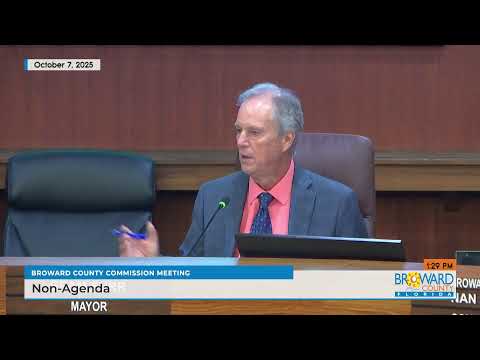
The Broward County Board of County Commissioners on Oct. 7 directed county staff to draft ordinance changes tightening taxicab vehicle and service standards, approving the motion unanimously after a daylong discussion and public comment.
County and industry staff framed the change as a tourism and safety measure ahead of large upcoming events and the county's push to present a consistent visitor experience. The board asked staff to prepare specific ordinance language for later consideration rather than adopting final rules at the meeting.
The board's action grew from a review the county is required to complete periodically of taxi regulations, including rates and vehicle standards. County staff summarized three stakeholder views gathered at meetings: the tourism industry recommended a five‑year vehicle age maximum and stronger appearance/branding standards; large fleet operators advocated a phased approach beginning with older fleets (15 years) and moving to 10 years for newly permitted vehicles; independent drivers and smaller operators emphasized affordability and opposed immediate rate increases.
Public speakers from the taxi and tourism industries urged compromise and speed. Joe Davis of Yellow Cab highlighted the company's investments in dispatch systems, wheelchair service and cameras, and he told commissioners taxi operators now handle specialized county programs including TOPS and late‑night safety rides. Tourism leaders said first impressions — the first ride a visitor takes after landing — were at stake and recommended driver training and a consistent, recognizable look for cabs.
After hearing from county staff, taxi operators and tourism representatives, the board endorsed a compromise approach: a default vehicle age limit of 10 years (rather than the 5‑year standard some hoteliers sought), with a package of accompanying standards to be drafted by staff. The standards the board asked staff to include in the ordinance draft or to return with proposals for were: cleanliness and interior/exterior condition standards, mandatory working air conditioning, visible driver credentials, digital payment capability, a unified county taxi visual identity/logo, driver recruitment and customer‑service training, performance monitoring (including rider feedback), and incentives or recognition for hybrid/electric vehicles. Commissioners also asked staff to allow a process for limited exceptions (for specialty or historic vehicle types) to be considered administratively.
Vice Mayor Bogan asked that county attorneys draft a companion resolution to extend protections against certificate abandonment so operators do not surrender permits while the ordinance work proceeds; staff agreed to return with language. County staff and operators also noted some context for the decision: transportation network companies account for roughly 80–85% of trips at Fort Lauderdale‑Hollywood International Airport, Yellow Cab said it expects to exceed 120,000 trips this year under county safety programs that previously totaled about 37,000.
The board's vote was procedural — direction to draft ordinance amendments and return to the commission — not final adoption. Commissioners repeatedly cited the timeline for the international IPW travel convention and for the county's expanded convention center as reasons to accelerate the work.
Commissioners who spoke in support emphasized balancing tourism goals with affordability for small operators. Several commissioners pressed for both interior and exterior standards, and asked staff for an administrative waiver path for unusual vehicle types so the county would not inadvertently block specialty operators.
The board had a unanimous procedural vote to direct staff to prepare proposed ordinance language and related materials for future hearings; no final regulatory text was adopted on Oct. 7.
The county will return later with a draft ordinance specifying age limits, inspection criteria, enforcement processes and any proposed incentives or exemptions.