Get Full Government Meeting Transcripts, Videos, & Alerts Forever!
Get email alerts on the Opioid Recovery Core topic
No spam. Unsubscribe anytime.
Bradford County authorizes staff to pursue CORE opioid-recovery funding, expands mobile MAT services
Summary
The Bradford County Commission voted 5-0 to authorize staff to move forward with coordinated opioid recovery (CORE) funding and a CRP expansion after a presentation by Lieutenant David Weeks on the county's mobile medication-assisted treatment work and funding plan.
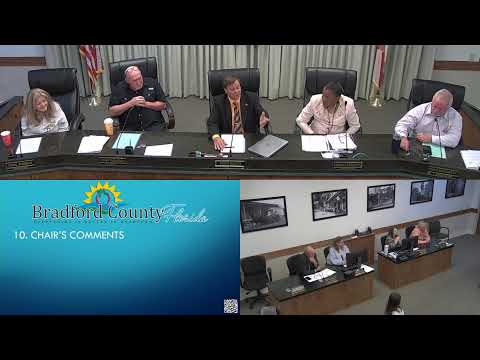
Bradford County commissioners on Oct. 7 voted 5-0 to authorize staff to move forward with coordinated opioid recovery funding and a CRP expansion proposal after a presentation on the county's CORE (Comprehensive Opioid Response) program by Lieutenant David Weeks of Bradford County Fire Rescue.
Weeks told the board CORE is "an innovative integrated solution expanding Florida's capacity to respond to the full spectrum [of] substance use disorder," and described how Bradford County's fire-rescue-led mobile medication-assisted treatment (MAT) and partner referrals now meet requirements to be designated a CORE county.
The CORE designation allows the county to receive state-administered opioid-abatement funding overseen by LSF, Weeks said. He said the overall award for year one is $700,000; he told commissioners that Bradford County Fire Rescue's share for year one is $459,617. He said year two award projections include $350,000 for the county and an estimated county-year-two cost of $164,000. Weeks said the program expects continuing funding beyond year two but did not provide a complete multi-year breakdown in the meeting record.
Weeks outlined program components: 24/7 access to medication-assisted treatment (he said paramedics are trained to give Suboxone in the field), coordinated referrals to Meridian for longer-term care, distribution of naloxone kits at stations and in the community, a mobile support unit used for field dosing and outreach, and one-on-one follow-up with patients. "These are 5 patients who received this resource that wasn't available 6 months ago," Weeks said, citing August 1'Sept. 15 program data showing five patients dosed in the field, three of whom remained in treatment (a 60% retention figure for that sample). He also said the county has received about 30 referrals in the past six weeks.
Weeks described a proposed grant-funded community paramedicine position to coordinate CORE locally. He said the position would be paid from CORE funds and would be removed if the grant funding ended: "this will just kinda overview what I foresee this position to be ... if these funds run out in 4 years and we're not able to cover them, that position is gonna go away," he said.
Commissioners asked about referrals from the jail, weekend physician coverage at Meridian and how prescription pickup and emergency prescription costs would be handled. Weeks said Meridian already provides some jail-based referrals and that, in urgent cases, Fire Rescue staff will pick up prescriptions in-county. He also said the county has a Model Communities grant for ongoing data collection and that staff can provide transport and limited emergency prescription payments when needed.
County manager (name not specified) made the motion to authorize staff to move forward with the coordinated opioid recovery funding and CRP expansion proposal "as presented." The board voted 5-0 to approve the motion.
The authorization directs staff to continue planning and to pursue the identified CORE funding and program expansion, including recruiting the grant-funded community paramedicine coordinator and continuing partnerships with Meridian, the sheriff's office and other health providers. Weeks and other staff will return with implementation details and any contractual agreements associated with the grant awards.