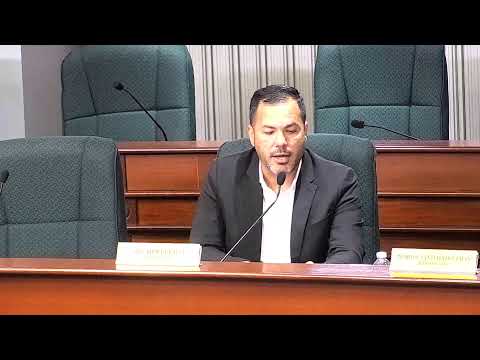
House committee holds hearing on bill to exempt municipalities from CRIM tax debt when acquiring properties
Loading...
Summary
A House committee heard public testimony on P. de la C. 591, which would amend Article 7.071 of Puerto Rico's municipal code to exempt municipalities from paying certain CRIM tax debts when acquiring real property. Presenters endorsed the measure, CRIM said it supports added tools, and lawmakers requested data before further action.
A House of Representatives committee held a public hearing Oct. 22, 2025, in Hearing Room 1 on Proyecto de la Ce1mara 591 (P. de la C. 591), a bill to amend Article 7.071 of the Código Municipal de Puerto Rico to exempt municipalities from paying accumulated municipal tax debt to the Centro de Recaudacif3n de Ingresos Municipales (CRIM) on properties the municipality acquires by purchase, expropriation, donation or acquisitive prescription.
The measure drew support from the Federación de Alcaldes de Puerto Rico and the Asociacif3n de Alcaldes de Puerto Rico, which told the committee the exemption would ease upfront fiscal burdens that often make rehabilitating or repurposing abandoned properties infeasible. Javier Garceda Cintrf3n, CRIM's interim director, told the committee the agency is "de acuerdo con el proyecto" and said the bill would give municipalities additional acquisition tools. Verf3nica Rodredguez, executive director of the Asociacif3n de Alcaldes, urged a straightforward exemption and said that under current reimbursement rules CRIM retains "cerca de un 25 o un 30 por 100" of reimbursed amounts.
Why it matters: Presenters said the current requirement that municipalities pay outstanding municipal tax debt before acquiring or rehabilitating a property can exceed a property's market value and block redevelopment of sites that contribute to blight, safety concerns and lost economic opportunity. Supporters argued an exemption would free municipal operating funds for acquisition and rehabilitation work and accelerate local revitalization efforts.
Supporters' testimony and recommended safeguards
Ángel Morales Ve1zquez, executive director of the Federación de Alcaldes, said the bill would remove a "carga contributiva" that limits municipalities' ability to rehabilitate abandoned properties. Verf3nica Rodredguez said the Asociacif3n endorses the bill "de manera cualificada" and recommended language ensuring the CRIM can still protect the government's fiscal interests; she also described the association's preferred approach as an "exoneracif3n total" rather than leaving extensive negotiation authority to municipalities.
Rodredguez and other witnesses told the committee the bill as drafted contemplates exempting debts (including interests, surcharges and penalties) when they are 75% or more of the property's market value; that threshold was discussed as a way to focus the exemption on properties burdened by large legacy debts. CRIM's interim director said the bill would "crear me1s herramientas a los municipios" and that operational details could be harmonized with existing CRIM procedures and Resolution 20-23-18.
Questions from legislators and data request
Lawmakers pressed presenters on implementation details: what metrics would ensure municipalities rehabilitate exempted properties, how other encumbrances (municipal fines, liens, utility debts) would be treated, and whether municipalities have administrative capacity to manage potentially large numbers of acquisitions.
Representative Santiago Guzme1n asked for concrete, quantifiable estimates of potential savings per municipality. Verf3nica Rodredguez said the exact fiscal impact varies by property and municipality but estimated that under the current reimbursement formula CRIM retains roughly 25% to 30% of the amount paid by a municipality when CRIM later reimburses the municipality. The committee chair asked CRIM to provide a county- and municipality-level report on properties declared "estorbo pfablico" and related debts for the past five years.
CRIM committed to providing those data. The committee set a 10-day deadline for CRIM to deliver an itemized report, which the chair and multiple legislators said is necessary before the measure advances.
No final action taken
No vote or formal motion to advance P. de la C. 591 was recorded at the hearing. Presenters and lawmakers said the hearing was informational and that the committee will consider the CRIM data before scheduling further action.
Quotes
"Eximir al municipio de esta deuda contributiva no es un privilegio, sino una medida de justicia fiscal y eficiencia administrativa," said c1ngel Morales Ve1zquez, executive director of the Federación de Alcaldes de Puerto Rico.
"El CRIM este1 de acuerdo con el proyecto," said Javier Garceda Cintrf3n, interim director of the Centro de Recaudacif3n de Ingresos Municipales.
"El CRIM se queda con parte de ese dinero, con cerca de un 25 o un 30 por 100," said Verf3nica Rodredguez, executive director of the Asociacif3n de Alcaldes of Puerto Rico, describing the agency's reimbursement retention under current practice.
Next steps
The committee asked CRIM to provide a municipal breakdown of properties declared estorbo pfablico, the debts associated to those properties and the reimbursements made under current rules for the past five years. Lawmakers said the committee will review that evidence before considering amendments or a vote on P. de la C. 591.