Get Full Government Meeting Transcripts, Videos, & Alerts Forever!
Get email alerts on the Budget Priorities topic
No spam. Unsubscribe anytime.
Manhattan CB2 adopts top three district needs for FY27, including mobile mental-health unit and 2 Howard acquisition funding
Summary
Manhattan Community Board 2’s Executive Committee voted to endorse three top district needs for FY27: an intensive mobile mental-health treatment unit, funding to pursue acquiring 2 Howard for affordable housing, and capital technology for Harvest Collegiate High School.
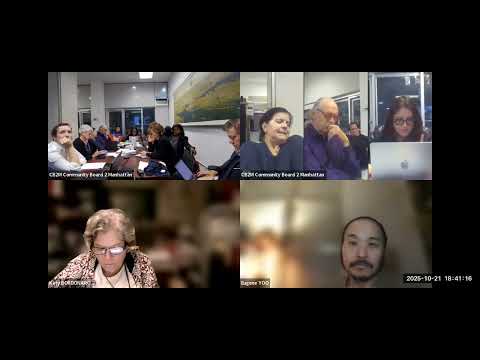
Manhattan Community Board 2’s Executive Committee voted to endorse three “top 3” district needs for the fiscal year 2027 budget at its October executive committee meeting. The items the committee advanced to the full board are: intensive mobile treatment for people experiencing homelessness and mental-health crises; allocation of city funds to pursue and acquire the 2 Howard site for affordable housing; and capital technology funding for Harvest Collegiate High School.
The committee chair, Valerie Dela Rosa, opened discussion on the board’s budget priorities and asked members to propose and rank items. Committee members debated alternatives before coalescing around the three items. Mark (last name not specified) and Eugene (last name not specified) recounted recent outreach with City Planning and agency contacts on 2 Howard; members emphasized that keeping the item on the list supports advocacy even if the city’s articulation of priorities changes under a new administration.
The committee discussed trade-offs between large, multi-year capital projects and more immediate expense items. Several members pressed for school technology funding and for continuing support for homeless and mental-health services. Members also flagged Canal Street and Hudson waterfront resiliency as important but less feasible in the short term without major capital commitments.
After discussion the committee took a voice vote to adopt the three top district needs and then voted to approve the broader slate of agency-by-agency budget priorities (capital and expense) to send to the full board. Committee members voted “Aye” on the top three and on the full slate; the transcript records the voice approvals but does not provide a named roll-call tally.
The committee did note outstanding data gaps that remain unresolved in the record. For example, members asked for more detail about funding sources and service capacity for certain human-services requests (including an item from The Door seeking expanded meal capacity), but committee members agreed not to delay the vote while awaiting additional agency data. Several speakers urged staff to incorporate written clarifications and to remove or update agency responses copied from last year’s documents before publishing the final version.
The board will present the adopted top three district needs and the agency-prioritized slate to the full board for a vote at a later meeting, per the committee’s process.
Ending: The committee chair said staff will consolidate edits into a single working document for circulation, and the approved district needs and slate will be forwarded to the full board for final consideration.