Get Full Government Meeting Transcripts, Videos, & Alerts Forever!
Get email alerts on the Criminal Justice Priority Setting topic
No spam. Unsubscribe anytime.
Washington County CJCC adopts priorities, accepts JMI technical-assistance grant and sets bimonthly meetings
Summary
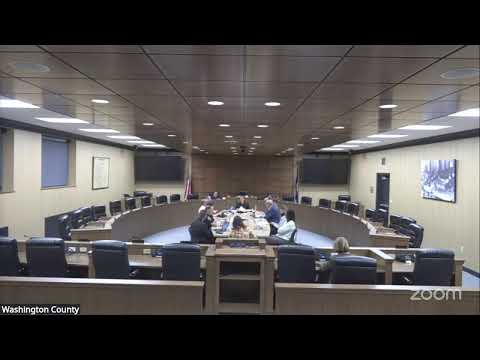
The Washington County Criminal Justice Coordinating Council voted Thursday to adopt strategic priorities developed by the Justice Management Institute (JMI), accept a JMI technical‑assistance award with a county match, and begin work on data sharing and alternative-program oversight.
The Washington County Criminal Justice Coordinating Council voted Thursday to adopt a set of strategic priorities developed by the Justice Management Institute (JMI), accept a technical-assistance grant from JMI with a county match, and begin work on data sharing and alternative-program oversight.
Council members agreed the priorities — strengthening CJCC governance, behavioral health, and pretrial components, with data integration and alternative programs as crosscutting considerations — will guide subcommittee work. The group also approved using a JMI technical-assistance award (up to $10,000 from JMI and a $10,000 county match) to help craft a strategic plan and build subcommittee structure.
The priorities came from a multi-page JMI report and a one‑page executive summary provided to the council. The chair told members the report is a tool to guide the CJCC’s next steps and said adopting the priorities does not constitute automatic endorsement of every specific action recommended in the document. "We do not have to take any action that adopts this report or formalizes it in any way," the chair said during the discussion.
The council amended the motion to treat the appendix C items as considerations for planning rather than mandatory solutions and approved the amended motion by voice vote. Members repeatedly stressed the difference between selecting priorities and committing to specific operational steps, particularly where budgetary implications are involved.
Public defenders, prosecutors and judges described a recent surge in filings that has strained court dockets and defender resources. "The increase in the number of case filings has... crippled my office," said Attorney Parham, who said his office is outnumbered by filings and lacks sufficient staff to assign representation in all eligible cases. A judge and other attorneys described a recent change in case assignment intended to consolidate multiple related appearances before a single court official, which they said is expected to reduce inefficiencies.
On the technical-assistance award, the chair said JMI had earlier announced a larger opportunity but ultimately offered Washington County up to $10,000 with a required dollar-for-dollar county match; if accepted, the combined resources would support a start-to-finish strategic-planning engagement tied to the priorities the CJCC approved. The chair and staff noted JMI could hold the award only for a short window and asked the public safety committee to consider the county match promptly so the opportunity would not be lost. "They could hold it probably for a couple of weeks at the longest," a JMI contact said, according to meeting discussion.
The council approved a motion (mover: Mr. Seager; second: Andy Freeman) to accept the grant with the 50% county match and to direct staff to finalize scope and contracting details if the county’s strategic-priority funds are made available by the public safety committee.
Members discussed data integration and sharing as an immediate next step. Participants identified three county offices as starting points for assembling and presenting data to the CJCC: the county IT office (referred to in the meeting as Dr. Robert’s office), the Budget, Policy & Analytics department (Aaron Dull), and the GIS department (Eric Damcott). The group agreed to convene those staff to explore whether a dashboard or other digestible reporting format could be produced from agencies’ existing data streams. The chair said JMI and the CJCC coordinator would help define key performance indicators and draft any necessary data‑sharing memorandum of understanding (MOU).
The council also discussed alternative-to-incarceration programs. The chair noted the Drug Treatment Court Coordinating Council (DTCCC) already meets quarterly, maintains program census and outcomes data, and can provide historical information to the CJCC. Program leaders told the council they already share quarterly data and are willing to explain program eligibility, outcomes and processes in a foundational session before the CJCC dives deeper into program-specific concerns.
Separately, the council approved a motion (mover: Andy Freeman; second: unnamed) to provide minimal CJCC contact information to the Wisconsin Department of Justice for the state’s local-program map listing; members agreed the submission would include a start date, AJCC contact (Attorney Stern was proposed), email, phone and an address.
On scheduling, members approved moving to bimonthly meetings, and a subsequent motion established the meetings for the second Tuesday of even-numbered months at 7:30 a.m., beginning in December 2025; specific dates will be circulated for calendar placement.
The council closed with instructions for next steps: staff will bring the JMI scope, contract terms and the county funding request to the public safety committee for approval of the matching funds; staff will also convene identified county data experts and schedule a foundational briefing on alternative‑program operations and outcomes. The meeting adjourned after the motions passed by voice vote.