Get Full Government Meeting Transcripts, Videos, & Alerts Forever!
Get email alerts on the Hccbg Units Services topic
No spam. Unsubscribe anytime.
Buncombe County HCCBG advisory panel questions providers' reporting, payment timing and scoring tool as funding tightens
Summary
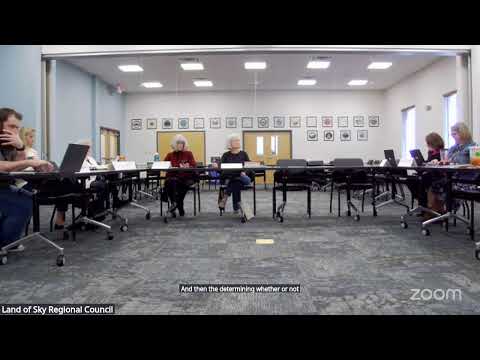
Members of the Buncombe County Home and Community Care Block Grant (HCCBG) Advisory Committee on Oct. 27 questioned unusually high provider-reported utilization figures, payment timing differences between legal and non-legal providers, and proposed simplifying the grant scoring tool.
Members of the Buncombe County Home and Community Care Block Grant (HCCBG) Advisory Committee spent much of the Oct. 27 meeting poring over the units-of-service report and supplemental aging funds, raising questions about high reported service rates, payment timing and how the committee evaluates grant applications.
Committee members flagged one legal services provider listed in the report at 653% of its grant "served" and asked staff to research how the provider calculated that figure. The committee noted that some providers enter every service unit performed even after the provider's grant funding is exhausted, producing very large percentages in the management system. The committee asked staff (identified in the meeting as Zach) to follow up with providers and report back at the next meeting.
Members discussed two payment schedules that affect reported figures. According to discussion during the meeting, most providers are paid monthly in roughly 1/12th installments, which can create a backlog of "units served but not reimbursed". Legal-service providers were described in the meeting as being eligible for near-immediate reimbursement up to their yearly budget (described during discussion as a 100% payout method), a difference that can make legal providers appear to be carrying receivables or to show higher utilization in the tracking system.
Other specific service-provider notes from the meeting included:
- Jewish Family Services' group respite program is recorded at about 93% of its grant served in the units report. - A transportation provider referenced as "Wheels on Wheels" was described as roughly halfway through its funding. - Mountain Mobility invoices are delayed or being corrected; committee staff (Alyssa was noted as monitoring this) said corrected invoices will be added to future reports, which may change utilization percentages.
Committee members said providers may have multiple funding sources; that may mean some providers are serving older adults regardless of HCCBG funding while HCCBG dollars help ensure those services are dedicated to older clients. The committee discussed the policy and program implications of that distinction but did not adopt a funding reallocation at the meeting.
The panel also reviewed the grant application and scoring tool. Several members said the current numerical scoring sheet does not fit well with qualitative program descriptions and suggested simplifying the form. Proposed changes discussed included turning some numerical items into yes/no checks (for example, whether a program plan is well defined), moving budget and fiscal-detail questions toward the end of the application, and making clearer questions about coordination with other agencies and evidence of community need. One committee member suggested removing a standalone diversity/equity/inclusion section to reduce confusion; another proposed requiring applicants to list partner organizations to demonstrate coordination.
Operational and scheduling decisions made during the meeting included staff circulating an editable Word version of the application, committee members preparing suggested revisions as homework, and scheduling the next meeting for Nov. 19 from 3:30 to 5 p.m. to review an updated application and scoring tool.
No formal funding reallocations were approved at the meeting. Members recorded several follow-up tasks for staff, notably: follow up with the legal services provider about its reported units and calculation method; confirm Mountain Mobility invoice corrections; and circulate the editable application and proposed scoring tool revisions before the Nov. 19 meeting.