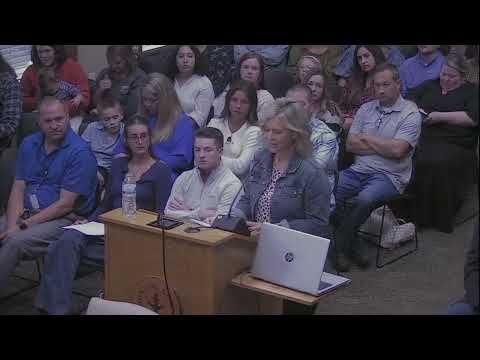
City presents FY26 plan for municipal road aid and coal severance funds; $2 million allocated to street overlay
Loading...
Summary
At a public hearing, city engineers outlined the proposed FY26 budget for municipal aid (liquid fuel tax) and coal/mineral severance funds, including a $2 million overlay (paving) program, $700,000 for Commerce Street rehab and a new $200,000 pavement-preservation pilot.
City engineers presented the proposed FY26 spending plan for municipal road aid (liquid fuel tax) and coal and mineral severance tax revenues at a public hearing; the commission heard project-by-project allocations and estimated year-end fund balances.
Melissa Chancellor, city engineer, said the FY26 plan begins with a fund balance of $1,501,000 and projects revenues (municipal aid funds, transfers and interest) of approximately $3,303,000, with proposed expenditures of $3,300,000 and an estimated ending balance of $1,504,000. Major FY26 allocations from liquid fuel tax funds include:
- $2,000,000 for the overlay (street paving) program; bids were out and staff expected work this fall and completion next spring, covering roughly 12 miles of streets. Staff said ADA ramp upgrades would be included on those streets as needed. - $200,000 for a new pavement-preservation program aimed at prolonging pavement life on low-volume residential streets as a lower-cost alternative to full paving. - $400,000 for sidewalk, curb and gutter rehabilitation, with a focus on the West End (zone 2C) and full rehab using concrete-cutting methods and targeted work on Tenth Avenue. - $700,000 proposed for full rehabilitation of Commerce Street (off Plum Springs Loop) to address wear from heavy traffic.
On coal and mineral severance funds, staff reported an FY26 starting balance of about $145,000 and projected revenue of $42,000, with no current allocations; staff said the funds are often held in reserve for winter salt purchases and estimated an ending balance of $187,000 for FY26 if no disbursements are made.
Staff said the overlay bids were active and that the commission would not vote on the hearing item; commissioners asked no substantive questions and the city manager and engineer invited comments. The presentation emphasized using a mix of full rehabilitation and targeted preservation to stretch funds while addressing ADA compliance and higher-need corridors.