Lawmakers, residents press to ease permits for mechanical removal of Lake St. Clair "muck"
Loading...
Summary
The Michigan House Natural Resources and Tourism Committee heard testimony on House Bill 4314, sponsored by Representative Saint Germain, which would loosen permitting for mechanical removal of floating algae and organic debris on private and some public shorelines of Lake St. Clair. Supporters said quicker mechanical removal is needed to protect,
LANSING — The Michigan House Committee on Natural Resources and Tourism on Wednesday heard testimony on House Bill 4314, sponsored by Representative Saint Germain, which would streamline or exempt certain mechanical removal of free-floating algae and organic mats — described repeatedly in testimony as "muck" or ammolae — from the permitting requirements administered by the Michigan Department of Environment, Great Lakes, and Energy (EGLE).
Supporters told the committee that allowing private property owners and contractors to use weed-harvesting equipment and other mechanical means without the current lengthy permitting process would let homeowners, marinas and municipalities act sooner to remove surface biomass from coves and shorelines before it consolidates and becomes more costly to remove.
"We don't need any more bureaucratic hurdles. We need to fix this now, not later," Representative Saint Germain told the committee, urging a faster path for mechanical removal that she said would protect boating, recreation and waterfront property.
Testimony from Macomb County and local business owners described the scale and local impacts. John Kerrin, community services coordinator for Macomb County Public Works and a St. Clair Shores city councilman, said a recent two-year study with the U.S. Army Corps of Engineers supported mechanical removal and disposal as an acceptable management strategy and that the state provided an $800,000 appropriation for a pilot cleanup. "This legislation to enable the removal of debris that has floated to the surface and deposited longshore does not impact" the factors that require dredging permits, Kerrin said, adding that dredging — which changes the lake bottom — properly requires a separate, detailed permitting process.
Steve Dobreff, owner of Freedom Boat Club of Lake St. Clair and a marina operator, described how the material has grown near marinas and canals, closing water access at some docks and creating hazards. "It used to be the area when we grew up — that's where we go water skiing — and because it's a protected area ... it's now clogged with this muck," Dobreff said, recounting a member's motor becoming fouled and a vessel running aground after striking submerged material.
A speaker from an organized citizens group, Save Lake Saint Clair, told the committee the problem affects far more than waterfront property owners and warned of water-quality consequences. "Forty percent of the state of Michigan's drinking water comes from Lake St. Clair," the speaker said, arguing the floating biomass acts like "a sponge of nastiness" that can concentrate pollutants and sewage overflows.
Representatives from EGLE, including legislative liaison Dylan Gebhard and Jared Sanders, director of the Water Resources Division, said the agency shares the goal of addressing the problem and is participating in a local task force with federal and county partners. Sanders cautioned that the statutory language must be targeted so it does not unintentionally authorize activities that would amount to dredging and thereby trigger additional federal approvals. He noted the department already has an expedited minor-project category that can permit some mechanical removal for a $100 fee and for up to five years and stressed the need to preserve synchronization with federal water-quality and coastal-zone certifications.
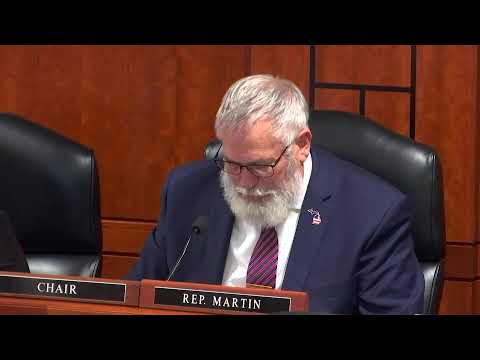
Committee members pressed for clarity about distinctions between surface removal and dredging, and whether the bill's broad phrasing — specifically, the term "mechanical means" — could allow heavy equipment capable of altering the lake bottom. "One of our concerns is that that line isn't necessarily drawn right now," Sanders said, calling for refining definitions and limits.
Rep. Woodin and other lawmakers asked whether EGLE would participate in follow-up drafting; both EGLE and the bill sponsor indicated they would continue to work on language. The committee did not vote on the bill Wednesday; members scheduled additional hearings and follow-up meetings with EGLE and local partners.
The committee also heard that a multi-agency pilot program funded in the recent state budget — described in testimony as an $800,000 appropriation for a pilot cleanup involving the Army Corps and Macomb County Public Works — is beginning to select pilot locations. Macomb County officials said a prior two-year, roughly $400,000 study produced a management framework that recommended mechanical removal and disposal as one acceptable method going forward.
Supporters urged swift action to allow private contractors and local governments to remove accumulated surface material before it consolidates and becomes more expensive and potentially hazardous, while EGLE urged careful statutory drafting to avoid creating a loophole that could spur unintended dredging activity or complicate federal permitting.
Next steps: EGLE and Representative Saint Germain said they will work on statutory language to narrow the bill's scope and define permissible mechanical methods; the committee expects further testimony from EGLE and federal partners as pilot locations are finalized.