Get Full Government Meeting Transcripts, Videos, & Alerts Forever!
Get email alerts on the Use Of Force Technology topic
No spam. Unsubscribe anytime.
Committee hears demonstration and expert testimony on bill to authorize electronic glove "de-escalation" devices
Summary
Representative Mueller sponsored House Bill 48-43 to update Michigan law to acknowledge modern electro-muscular disruption glove technology for law enforcement and certain security personnel. Vendors and law-enforcement representatives testified; the ACLU of Michigan submitted a written opposition card.
The Michigan House Judiciary Committee heard testimony on House Bill 48-43 on technology described by proponents as an electro-muscular disruption, conductive distraction and de-escalation glove. Representative Mueller introduced the measure and said the bill would update Michigan law to allow modern devices that can be used by law enforcement and by private security officers who are CPL-certified.
Representative Mueller said the proposal would “legalize electronic glove technology” and that the bill limits possession to law enforcement and CPL-certified security in settings such as hospitals; “No civilians will be able to purchase these items,” he said on the record.
Jeff Kirkpatrick, representing the Michigan Court Officer/Deputy Sheriff's Association, said the bill would update language in existing law. Kirkpatrick told the committee that earlier legislative language had authorized use of then-current TASER devices and that “the technology continues to evolve.” He identified the statutory target as an amendment to Public Act 328 of 1931.
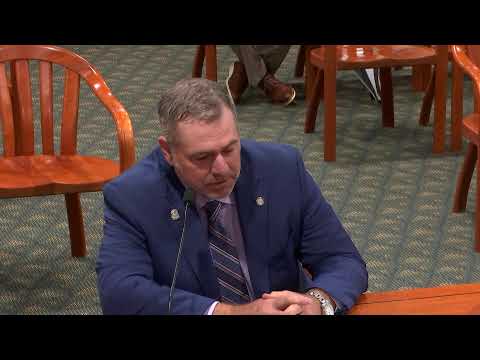
Jeff Nicholas, founder and chief executive officer of Compliant Technologies, demonstrated the company’s glove and described technical and training features. Nicholas said the device stimulates the outer layer of skin and “no current enters the body,” and he asserted the device “leaves no burns, marks, or scars.” He told the committee the device is designed to activate only on exposed human skin and not through clothing, hair or metal, and he said recorded event data are stored in a data-management portal to provide an audit trail.
Company testimony included technical specifications cited by Nicholas: he said the glove operates at roughly 300 volts and under half an amp and that, by using a larger contact surface, it achieves an effect with substantially less current than some other devices. He described a typical encounter as often stopping within a few seconds and said the company trains agencies on application levels and record-keeping. Nicholas also told the committee the company’s quoted MSRP is about $1,795 per pair and said the company indemnifies smaller agencies against certain product-liability judgments.
Committee members asked technical and policy questions. Representative Harris, who identified herself as a former TASER instructor, told the witness she was “very curious to learn more” and noted the value of audit trails for court testimony. Representative Scott asked whether the committee could see a demonstration; a live demonstration of the glove followed in the hearing room. Committee members asked whether the device affects pacemakers or defibrillators and whether it works in rain; the witness said the company had tested such situations and asserted that pacemakers and defibrillators would not be affected and that the device can be used in rain with standard precautions.
Support and opposition were logged on the record. Cards submitted in support included Ron Wiles, executive director of the Michigan Association of Chiefs of Police; Matt Saxton of the Michigan Sheriffs Association; and Kyle Kaminski of the Michigan Department of Corrections. A written card of opposition was submitted by Brial Dresner of the ACLU of Michigan.
The transcript records committee questions and a demonstration but no committee vote on House Bill 48-43 during the session.