
Counselors, financial-aid directors and students describe affordability shortfalls, housing and dual-enrollment uncertainty
Get AI-powered insights, summaries, and transcripts
Sign Up Free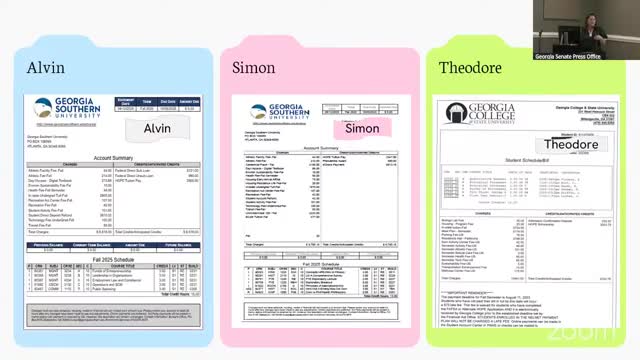
Summary
School counselors, university financial-aid directors and students told the Senate committee that unmet need, housing costs, FAFSA barriers and possible changes to dual-enrollment funding are driving students to work more and borrow more.
Multiple speakers at the hearing described how unmet need beyond tuition — housing, food, books, transportation and fees — forces students to take on excessive work hours or loans.
Daphne Epps, school counselor at John Milledge Academy in Baldwin County, told senators that several families assumed the HOPE scholarship would cover all college costs. She provided billing examples from local students showing first-semester bills of more than $9,000 and said one family took out $13,000 in personal loans when unmet need unexpectedly surfaced.
David Saladin, a counselor at Baldwin High School, described local rural demographics and said many parents and students treat tuition, fees and ancillary costs as one combined bill. "Parents and students, they don't consider those things moving forward because they had the luxury of having this [technology and services] since middle school," Saladin said, arguing that students must plan for additional college expenses like laptops and other incidentals that campus K–12 programs had previously covered.
Financial aid directors described campus-level consequences. Shannon Simmons, director of financial aid at Georgia College & State University (GCSU), reported that GCSU provided short-term institutional emergency support and used a 14-business-day extension past drop/add to reduce non-payment drops. Simmons said GCSU awarded about $78.6 million in financial aid in 2024–25 and that institutional and federal aid helped many students stay enrolled; still, a small number of otherwise-qualified applicants (13 in one admissions cycle she reported) were unable to enroll because of unresolved bills.
Kimberly Morris, director of financial aid at Fort Valley State University, testified that Fort Valley is a high-Pell campus (approximately 70% Pell recipients) and often serves students with high unmet need who arrive with few family resources. Morris described recurring front-line cases — students who cannot move in because their award packages are incomplete, students whose families cannot pass Parent PLUS credit checks, and students who must rely on small institutional emergency awards or donor-funded aid to remain enrolled.
Counselors and aid directors also discussed FAFSA barriers. Presenters said some families avoid or incorrectly complete tax forms, which complicates SAI/FAFSA calculations and can push students toward unsubsidized loans if parents refuse to provide required information. Speakers urged simpler eligibility and clearer messaging so families and counselors can know who is likely to qualify before an offer letter.
Dual enrollment: Counselors raised uncertainty about state dual-enrollment funding and application timing. John Milledge’s Daphne Epps said counselors were preparing for changes that could delay or change the February application timeline; state staff clarified that any changes to dual-enrollment funding would require legislative action, and that counselors were being advised about possible timing shifts.
Student testimony underscored financial pressure. Students from Fort Valley and GCSU described working multiple jobs, borrowing subsidized and unsubsidized loans, confronting housing scarcity and relying on work-study or campus jobs to survive. Several students — many first-generation — urged expanded need-based grants, expanded work-study and lower loan interest as ways to reduce barriers to completion.
Ending: Counselors and campus aid officials told the committee that an expanded, well-designed state need-based grant could reduce short-term institutional scrambling, lower student loan use and make completion more likely if paired with outreach, housing support and simplified eligibility.