Get Full Government Meeting Transcripts, Videos, & Alerts Forever!
Get email alerts on the State Street Master Plan topic
No spam. Unsubscribe anytime.
Santa Barbara council hires Moule & Polyzoides to finish State Street master plan, directs interim study
Summary
The City Council authorized a new contract with urban design firm Moule & Polyzoides to complete the State Street Master Plan and approved a feasibility study for centralized stormwater capture on State Street’s 700–900 blocks, while directing staff to return with interim circulation and public-safety options once studies are complete.
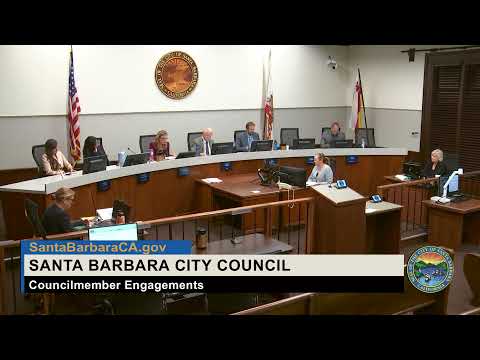
The Santa Barbara City Council voted unanimously Oct. 21 to authorize an amendment to the agreement with urban design firm Moule & Polyzoides to complete the long‑running State Street Master Plan and to begin a feasibility study for an off‑site stormwater compliance project on the 700–900 blocks of State Street.
City staff said the firm’s lead, architect Stefanos Polyzoides of Moule & Polyzoides, has the design and urban‑planning experience needed to deliver a concise master plan staff can act on. Tess Harris, the city’s State Street master planner, told the council she had grown “frustration” with delays and that the new agreement is intended to deliver a final plan to the council in early 2026. “It’s time to move forward,” Harris said.
Why it matters: The master plan will set a long‑term design and implementation framework for the city center — the blocks between Ortega and Carrillo streets — and is intended to guide decisions about public space, circulation, activation and redevelopment. Council also approved a separate feasibility review to study a centralized stormwater capture system that would allow redevelopment and reduce on‑site compliance costs in constrained downtown parcels.
What council approved: Council authorized the contract amendment with Moule & Polyzoides and appropriated funding to begin a feasibility analysis for an alternative stormwater compliance option on the 700–900 blocks. Staff said no new general‑fund money was required: the amendment will use unspent funds already budgeted for the State Street project (about $210,000) plus salary savings and a supplemental amount of $133,250 to complete the work. The creek‑and‑stormwater feasibility scope would examine capacity, water‑quality performance, and whether a hub system could accept in‑lieu contributions from private projects.
Council direction and follow‑ups: Councilmembers asked that the city return with interim operational options once the city’s circulation/public‑safety study is complete, and with input from the new consultant. The council’s motion — made by Councilmembers Sneddon and Friedman and seconded — directed staff to bring “possible options for interim solutions” after the circulation and public‑safety review, and to include Moule & Polyzoides in that interim discussion. The motion passed unanimously with a roll‑call vote: Harmon, Santa Maria, Sneddon, Friedman, Gutierrez, Jordan and Mayor Rouse all voting yes.
Discussion highlights: Harris told the council Moule & Polyzoides had already supported a staff workshop and produced design scenarios illustrating a “flat and flexible” street section that could be used for a variety of events and circulation patterns. She said the firm’s work includes economic and mobility analysis and that staff intends to condense draft master‑plan material into a readable document of roughly 50 pages focused on design, phasing and implementation. Council members pressed for a clear timetable for the circulation and public‑safety work and for a prompt interim plan that could be implemented before peak visitor season.
Stormwater study: Staff described the off‑site or centralized stormwater option as a potential compliance pathway for downtown properties that lack room for on‑site systems. The feasibility work will model capture capacity, water‑quality equivalency and construction constraints (including basements and subsurface utilities). Staff said the approach could reduce barriers to redevelopment in tight, lot‑line downtown parcels if the regional water quality board accepts in‑lieu compliance mechanisms.
Ending: Councilmembers and several public speakers urged speed and clarity after years of public debate over State Street’s long‑term configuration. Harris said the intent is to return a draft master plan in early 2026 and to present interim options tied to the consultant’s work and the city’s circulation and safety studies. The council’s vote sends the project to Moule & Polyzoides and starts the stormwater feasibility work immediately.
Speakers quoted in this article are listed in the speakers section below. All other meeting comments referenced here are recorded in the official meeting minutes and transcript.