Get Full Government Meeting Transcripts, Videos, & Alerts Forever!
Get email alerts on the Local News topic
No spam. Unsubscribe anytime.
Columbus forum examines trust, funding and AI’s role in the future of local news
Summary
Panelists at a Columbus Metropolitan Club forum debated how consolidation, funding models and technology are reshaping local journalism and public trust, and outlined strategies nonprofit and startup outlets are using to try to rebuild community confidence.
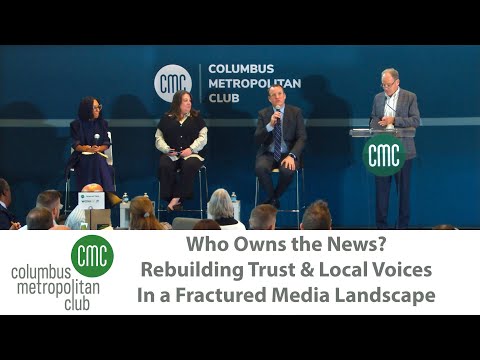
The Columbus Metropolitan Club convened a panel discussion titled “Who owns the news? Rebuilding trust and local voices in a fractured media landscape” at the National Veterans Memorial and Museum in downtown Columbus. Panelists and audience members discussed declining public trust in journalism, business models for local outlets, the effects of consolidation and the emerging role of artificial intelligence.
The forum brought together Philip (identified onstage as a former national columnist for The Washington Post and author of The Aftermath), Michelle Everhart Sullivan, chief audience officer at Signal Ohio, Teraya Palmer, co‑creator of the Columbus Can't Wait podcast, and host Mike Thompson of WOSU. Questions from the audience and a multi‑panel exchange focused on how local outlets can maintain independence and rebuild trust amid shrinking newsrooms and rising misinformation.
Why it matters: panelists warned that weakening local journalism reduces community oversight of government and civic institutions. They stressed that new business models — nonprofit memberships, community funding, and trained local documenters — are emerging as possible ways to support reporting that residents rely on for local government, elections and services.
Panelists cited recent polling and market trends to frame the problem. A Gallup poll referenced onstage put trust in the news at roughly 28 percent nationally; the panel cited a breakdown discussed during the event — about 8 percent of Republicans, roughly 51 percent of Democrats and about 27 percent of independents reporting at least a fair amount of trust — and noted that local news typically scores higher, at about 40 percent trust in some measures. Philip said, “I don't think anyone knows the solution to that problem,” arguing the scale and fragmentation of today’s media ecosystem make rebuilding broad trust difficult.
Local models and audience building Michelle Everhart Sullivan described Signal Ohio’s hybrid model of professional reporters and paid community “documenters” who attend public meetings and produce notes and reporting. “We have over a thousand people throughout Ohio trained now to do that,” she said, citing that network as a source of both coverage and membership engagement. Sullivan said Signal focuses on multiple metrics — unique visitors, time on site and social engagement — and uses newsletters and in‑market outreach to convert readers to donors.
Teraya Palmer described starting the Columbus Can't Wait podcast to fill a gap for hyperlocal perspectives, especially among younger Black residents. She said the program grew after adding video on YouTube and leaning into community relationships: “We have a small but mighty audience of people that are locked in and listen,” she said.
Ownership, philanthropy and legal risks Panelists weighed corporate ownership against local or nonprofit models. Philip, drawing on his experience at a national paper, said wealthy or corporate owners can fund large newsrooms but may change priorities over time; that instability can undercut institutions once seen as “sturdy oaks.” Michelle and Teraya said nonprofit and community‑funded models reduce some conflicts but require ongoing donor engagement. Teraya said her show relies on listener donations and community resources rather than corporate underwriting to avoid being “handcuffed” by funder expectations.
Panelists also flagged a rising legal risk: outlets face more frequent lawsuits and threat of litigation intended to exhaust smaller newsrooms’ resources. Philip said that strategy — whether from private litigants or political actors — poses a growing financial threat to local journalism that lacks the legal teams of larger organizations.
Technology, AI and verification Audience members asked about artificial intelligence. Panelists distinguished useful, narrowly applied AI — data extraction or code assistance — from AI’s “slop,” such as fabricated images and videos that can blur reality. Sullivan said Signal is drafting an AI policy and uses AI for analysis while double‑checking outputs: “When we do use it, we want to be very transparent about it.” Panelists warned that synthetic content can be used both to fabricate events and to cast doubt on real events, complicating verification and public trust.
Civic education and audience behavior The forum returned repeatedly to civic education and the public’s role in media literacy. Panelists said a decline in formal civics instruction and public statistical literacy makes people more susceptible to misinformation. They urged newsrooms to produce more “service journalism” — explainers about how government works and how residents can engage — and to use short social video and town halls to reach audiences who do not read long articles.
Takeaways and next steps Panelists recommended a mix of tactics: building community relationships, diversifying revenue beyond clicks, training local residents to document public meetings, investing in cross‑newsroom partnerships to cover news deserts and creating transparent AI policies. The session closed with audience questions and recommendations to support local journalism through donations, membership and civic engagement.
The Columbus Metropolitan Club encouraged attendees to continue the conversation at its next forum and highlighted resources including Philip's book, The Aftermath, available at the venue's book table.