
Committee backs giving hospital PICs more flexibility on technician duties and ratios; discusses infusion center licensing questions
Get AI-powered insights, summaries, and transcripts
Sign Up Free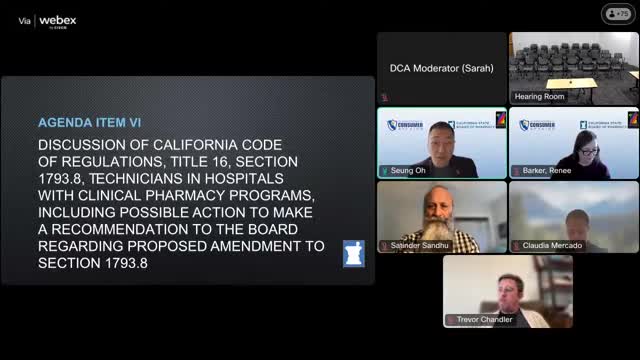
Summary
Members favored a model that lets hospital pharmacists in charge set non‑discretionary technician tasks and determine inpatient pharmacist‑to‑technician ratios; the committee also began an information gathering process about licensing and rules that apply to infusion centers.
The Licensing Committee on Oct. 15 discussed proposed amendments to two hospital‑focused regulations — CCR §1793.8 (technicians in hospitals with clinical pharmacy programs) and CCR §1793.7 (pharmacist‑to‑pharmacy‑technician ratio for inpatient settings) — and considered whether the board should adopt a new licensing approach for infusion centers.
What the committee proposed - Hospital technician roles: Staff presented draft language to let hospital pharmacists in charge (PICs) determine additional non‑discretionary tasks that properly trained pharmacy technicians may perform in hospitals that operate clinical pharmacy programs. Several members supported a flexible, PIC‑driven model that would require written policies, preceptor training, competency verification and periodic quality review.
- Inpatient ratio: The draft would replace a fixed, statewide ratio with language that allows the PIC to set an appropriate pharmacist‑to‑technician ratio "in connection with the dispensing of a prescription," while preserving safety oversight. Members noted the need for clearer wording about whether the ratio applies to dispensing for patient self‑administration (prescriptions) versus medication orders administered by clinical staff.
- Infusion center licensing: Committee members heard that infusion‑center practice often more closely resembles hospital pharmacy than a community retail pharmacy, yet most infusion providers are currently licensed under the same community pharmacy category. The committee asked staff to collect more information, including common business and care models, to decide whether targeted definitions or licensing changes are warranted.
Public comment and concerns CSHP supported a flexible model and said the draft authorizes contemporary hospital technician roles. Several system pharmacists urged careful drafting to avoid unintended limits on ambulatory infusion and clinic‑based services. Steven Gray and other commenters recommended clarifying whether the ratio applies to distribution for nurse administration at inpatient sites versus patient prescriptions going out the door.
Next steps Staff will return revised regulatory language that clarifies scope language (dispensing versus orders), competency expectations and monitoring requirements, and will collect written examples from infusion centers to inform any licensing or definition proposals. No vote was taken.
Clarifying details - Proposed change: allow hospital PICs to authorize additional nondiscretionary tasks for properly trained technicians; require policies and training documentation. - Proposed ratio change: permit PICs to set pharmacist‑to‑technician ratios for dispensing-related activity rather than mandating a single fixed statewide ratio.
Committee view Members favored a flexible, risk‑based approach that preserves PIC accountability and data‑driven monitoring.