
Licensing committee outlines steps to implement AB 1503: standard of care, remote processing, technician duties and nonresident pharmacy changes
Get AI-powered insights, summaries, and transcripts
Sign Up Free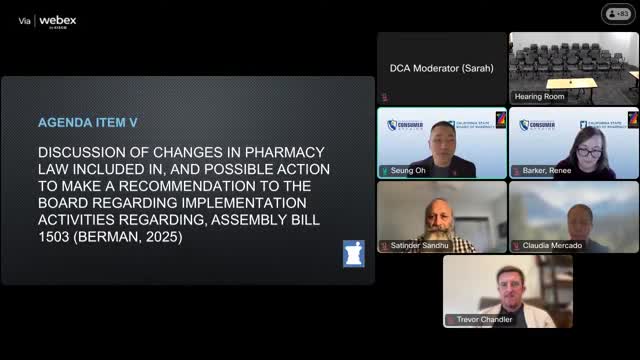
Summary
The Licensing Committee reviewed AB 1503 implementation tasks on Oct. 15 and asked staff to prepare FAQs, policy statements and draft regulation language to guide pharmacists, pharmacies and nonresident licensees.
The Licensing Committee spent the bulk of its Oct. 15 session reviewing implementation priorities and draft approaches for provisions of AB 1503, the board's recently enacted sunset bill. Committee members generally supported a broad, nonprescriptive "standard of care" approach that empowers pharmacists while asking staff to prepare clarifying materials for licensees and the public.
Key implementation areas discussed - Standard of care: Committee chair Song El said the new statutory standard of care will allow pharmacists to exercise professional judgment outside the confines of narrowly prescriptive regulations. Committee members favored a brief policy statement that describes the move away from rigid protocol lists toward a competency‑ and outcome‑based approach. Several commenters, including Richard Dang (USC faculty) and Sean Kim (CPHA), praised the change and urged timely guidance and stakeholder education.
- Remote processing and inspection authority: AB 1503 removes limits on pharmacists working outside a licensed pharmacy for dispensing-related tasks. The committee discussed draft language for remote processing and whether inspection methods should include physical inspections of private residences where pharmacy work is performed. Mark Johnston (CVS Health) and Steven Gray (longtime system pharmacist) urged caution about inspecting homes and suggested virtual inspections as a practical alternative. Committee staff said they would draft guidance and consider a policy statement to bridge the gap while rulemaking proceeds.
- Technician duties outside pharmacy walls: The statute allows expansion of technician duties performed outside a licensed pharmacy (for example, in clinic immunization settings or health‑system satellites). Committee members and public commenters stressed that pharmacies should have written policies and safeguards and that technician practice in nontraditional settings requires PIC oversight, documented training and appropriate privacy and cybersecurity protections.
- Nonresident pharmacy inspection and PIC requirements: The committee noted a July 1, 2026 effective date for a provision requiring the designated pharmacist in charge (PIC) for nonresident pharmacies to hold a California license and for the board to have inspection authority over nonresident facilities. Committee members asked staff to prepare FAQs and outreach for nonresident licensees; commenters requested clear guidance about how an out‑of‑state PIC should demonstrate compliance and whether the PIC must physically reside in California.
- Self‑assessment and enforcement changes: The committee supported integrating the statute's self‑assessment changes into the board's published materials and using the change to streamline forms and inspections.
Public comment and stakeholder input Public commenters included health systems, pharmacy associations and manufacturers. CVS Health urged expedited rulemaking for remote processing language but suggested virtual inspection options. CSHP, CPHA and system pharmacists recommended that PTAC and other stakeholder groups help craft FAQs and training materials.
Next steps Staff will draft policy statements, FAQs and possible regulation text for the full board to consider and will circulate proposed materials for stakeholder comment. Committee members emphasized the need for targeted outreach and clear, practical guidance to licensees as rule development moves forward.
Clarifying details - AB 1503 effective date for many changes: Jan. 1, 2026; some nonresident pharmacy PIC/inspection provisions effective July 1, 2026. - Committee requested draft FAQs and policy statements before formal regulation adoption to help employers and licensees comply.