
Layton council tables Hobbs Creek Villas rezoning after neighborhood objections and technical concerns
Get AI-powered insights, summaries, and transcripts
Sign Up Free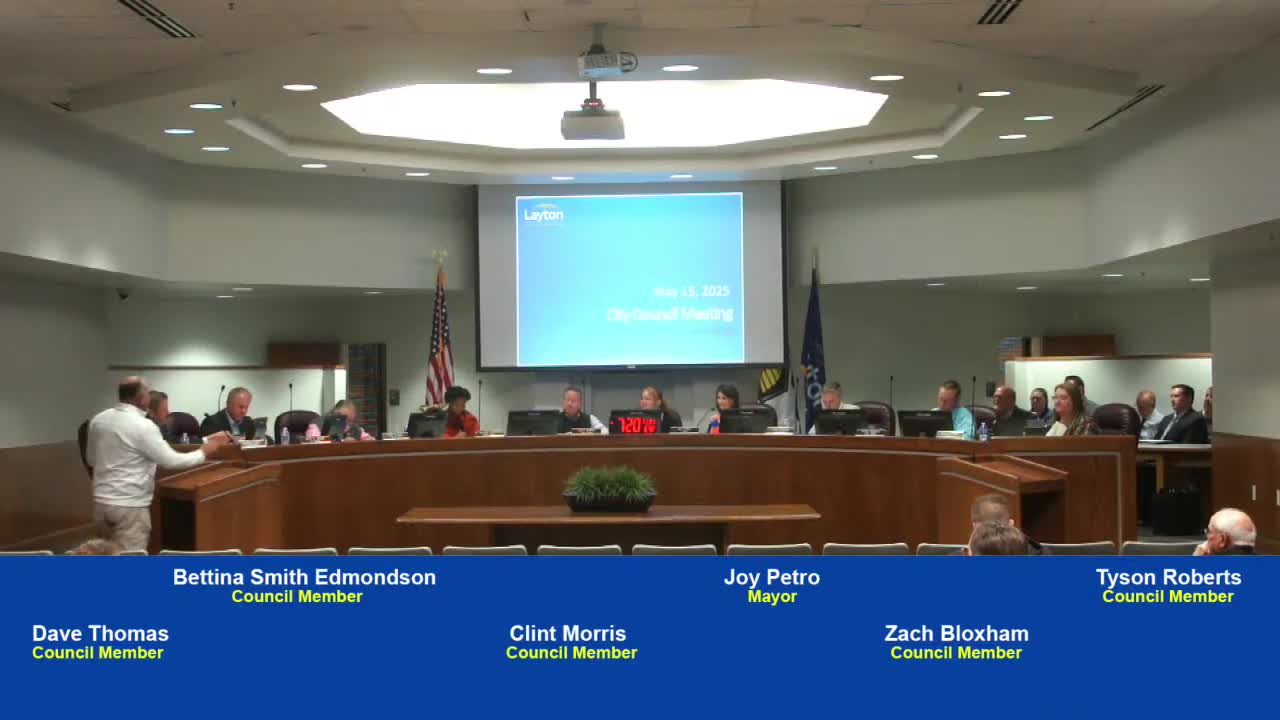
Summary
After extended public comment raising engineering, access and privacy concerns, the council closed public testimony and voted unanimously to table the Hobbs Creek Villas PRUD rezoning application to a date uncertain at the applicant's request.
Residents near the proposed Hobbs Creek Villas development urged the Layton City Council during public comment on May 15 to reject or delay a planned-residential-unit-development (PRUD) rezoning that would place new lots and a trail adjacent to existing homes.
At the meeting, multiple neighbors cited geotechnical and slope-stability concerns and warned potential buyers could have difficulty obtaining insurance or could face future slope failures. “I’m here to speak for the 27 families who want to live in that area,” said Michael Christiansen, who spoke in favor of building new homes but noted the rezoning raised broader neighborhood issues. Other residents, including Justin Anderson and Becky Anderson, asked the council to follow the city’s own PRUD standards and to consider alternatives that reduce impacts to existing properties.
Why this matters: Speakers raised three recurring concerns: (1) the proposed trail and public access would surround an existing property and change privacy/usage expectations; (2) slope stability and geotechnical uncertainty in steep areas — commenters cited past landslide problems elsewhere — could put future homeowners at risk; and (3) insurance and underwriting concerns for homes on steep ground could leave buyers and lenders exposed.
Council action and process: At the applicant’s request, the council closed the public hearing and unanimously voted to table the rezoning to a date uncertain so the developer can revise the proposal. The motion to close the hearing and table the item passed on a 5–0 roll-call vote. City staff and the city attorney clarified that tabling at the applicant’s request preserves the applicant’s option to resubmit and that the council previously met statutory and hearing obligations for this item.
What neighbors asked for: Speakers asked for clearer answers on whether similar single-family lots elsewhere in the city had been entirely surrounded by public access, for additional geotechnical study or engineering options that avoid cutting into the slope, and for zoning that better matches the adjacent single-family character. Several asked the council to deny or to require the developer to shift the trail alignment to reduce the impact to specific homes.
Ending: City staff indicated they will coordinate follow-up with the applicant when a revised submittal is filed. The item will return to the council when the applicant requests a new hearing date.