
Dakota County outlines $50 million Bilsby Dam upgrade, safety and emergency plans
Get AI-powered insights, summaries, and transcripts
Subscribe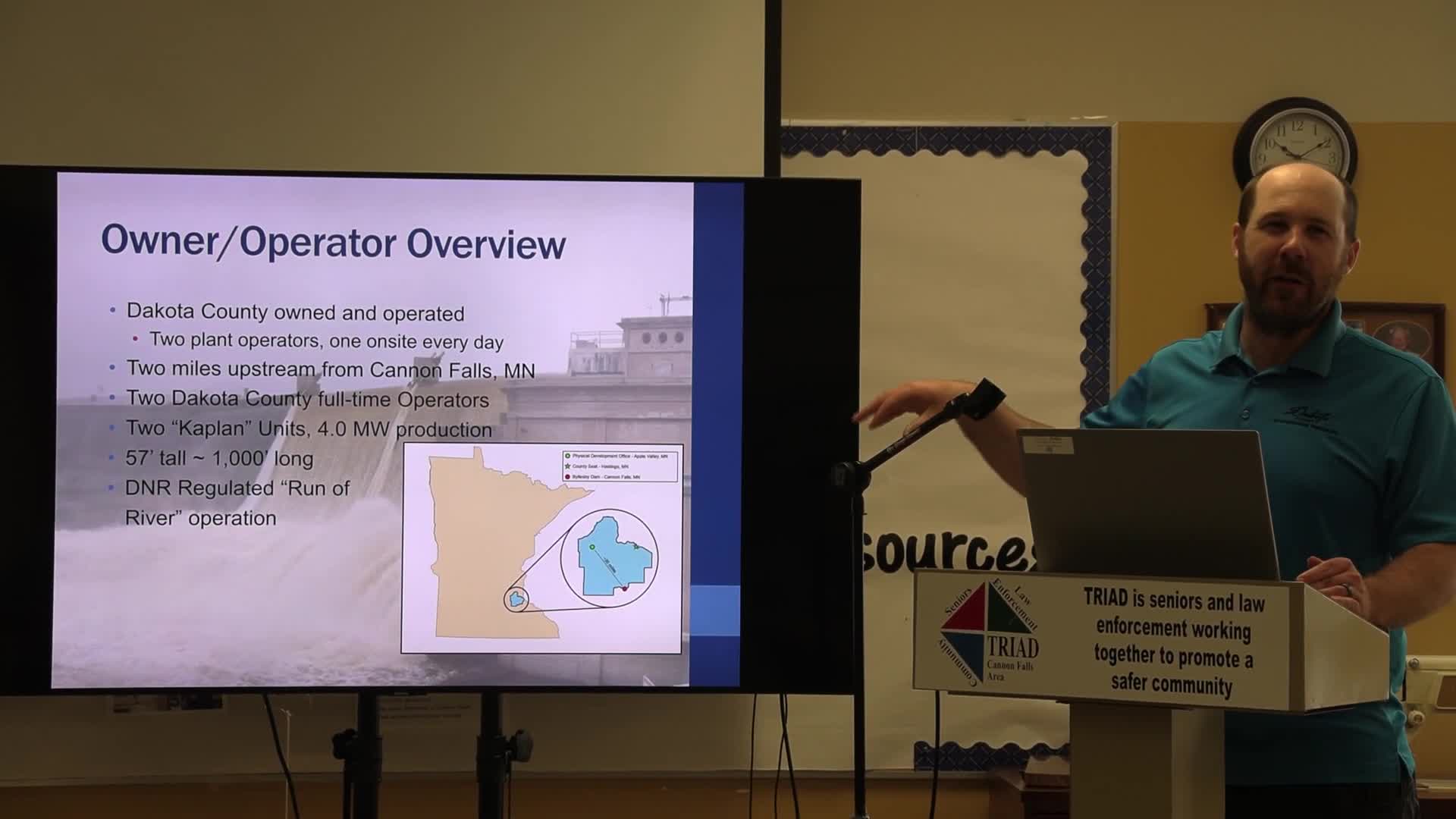
Summary
Dakota County officials described a multi-year powerhouse upgrade at Bilsby Dam that doubles generation capacity, adds structural and spillway upgrades, increases flood-passing capacity and updates emergency planning and public-safety measures for areas downstream of Cannon Falls.
Dakota County officials described a multi-year upgrade of the Bilsby Dam near Cannon Falls that nearly doubles the dam’s electricity output while adding structural and safety improvements and updated emergency planning.
Mark Ryan, senior water resources engineer for Dakota County, told local residents that the completed powerhouse upgrade will produce about 4 megawatts at maximum output, roughly double the roughly 2.3 megawatts the site produced with older equipment. “The output of the plant, once we’re fully up and running here is gonna be about 4 megawatts,” Ryan said.
The upgrade, Ryan said, encompasses new vertical Kaplan turbines, added concrete and a rebuilt downstream powerhouse to extend the facility’s service life and improve dam stability. The project also included a separate 2014 spillway upgrade with 65-foot-long, 14-foot-high crest gates designed to pass far larger floods than the dam could previously handle. Ryan said the overall project cost is now about $50,000,000, and that inflation and pandemic-era supply chain delays significantly increased costs and pushed schedules.
Why it matters: Bilsby Dam sits about two miles upstream of Cannon Falls and is considered a high-hazard facility because failure could inundate downstream neighborhoods and infrastructure. The upgrades aim to reduce breach risk, increase controlled flood capacity and maintain the reservoir relied on by local residents and recreation.
Most important facts first: The facility is operated by Dakota County and runs as a run-of-river plant, meaning operators cannot hold or release water beyond natural inflows; generation depends on river flow and may be zero during very low flows. Ryan said the facility now has two full-time operators on site and ties into regional power markets via MISO; Dakota County plans to sell power on the open market rather than through a previous power-purchase arrangement. “We can kind of sign up and say, I’m selling my power,” Ryan said, referring to Midwest Independent System Operator market processes.
Technical and safety details: Ryan described the dam’s roughly 55-foot head (the vertical distance water drops through the turbines) and said the new gates increased the facility’s rated flood-passing capacity from about 45,000 cubic feet per second (cfs) to about 80,000 cfs. He described the 2014 crest-gate project as a key risk-reduction measure that reduced the chance of overtopping during extreme floods. Ryan said the 2024 high-water event produced about 16,000 cfs at the dam (about 20,000 cfs at the Welch gauge) and that the region’s historically large flood occurred in April 1965.
Regulatory and inspection framework: Bilsby Dam is subject to dam-safety oversight. Ryan said the facility is below the threshold for a full FERC hydropower license because it produces under the licensing threshold, but the Federal Energy Regulatory Commission conducts annual dam-safety inspections and requires periodic independent consultant reviews roughly every five years. The county also operates under state permits and consulted the State Historic Preservation Office when restoring the powerhouse façade and windows.
Public safety and emergency planning: County staff described routine safety measures: navigational buoys (including heavier “Boatbuster” buoys) and signage, a designated no-access safety zone between the dam and a DNR pedestrian bridge, and an Emergency Action Plan that includes evacuation maps for properties in downstream impact zones. Ryan said Dakota County, Goodhue County, Cannon Falls emergency management and the city coordinate siren messaging and that the county can trigger sirens from the dam. He described public outreach conducted in May for Dam Safety Awareness and that the county mails informational pamphlets to residents in the evacuation area.
Operations and maintenance: Ryan said the county maintains daily operator coverage (two full-time operators are on staff) and monitors seepage and structural elements with crack monitors and other instrumentation. He outlined routine responses for observed cracking or seepage — monitoring for smaller issues and mobilizing contractors and engineers if a higher-risk problem develops.
Community concerns raised: Residents asked about personal safety near the river, the potential for tubes or boats to be drawn toward the gates, signage, and siren messaging. Ryan acknowledged those concerns and said signage and enforcement of the safety zone are the primary tools; he said the county is discussing whether to close access during certain high-flow events. He also said the county is reviewing how siren tests are announced and timed in coordination with local emergency managers.
Finance and timeline: Ryan said earlier refurbished turbines lasted roughly 35 years and that the new installation is expected to add “50-plus years” of service. He attributed the cost increase largely to inflation and longer lead times for electrical equipment; some components that once took months to procure now take one to three years. The county expects to market and sell generated power through regional market structures rather than an exclusive long-term contract.
No formal board action was taken during the meeting; Ryan’s presentation was informational and followed by resident questions. Dakota County staff did not propose, vote on, or adopt new policy during the presentation.
For more information, Ryan recommended county resources and federal gauge data (USGS) to follow river flows and future inspection schedules. He said the county will continue coordination with Cannon Falls and Goodhue County emergency managers on siren messaging and public outreach.