District hears two 10-year capital-plan options; consultants outline phasing, schedule and likely tax impacts
Loading...
Summary
Consultants from ICS presented “warm, safe, dry” and expanded renovation options for a 10-year capital plan and two borrowing scenarios ($129M and $164M). Consultants and the business office showed potential millage increases and household tax impacts; board and residents pressed for more enrollment, phasing and cost detail.
Consultants from ICS presented two financing options for a 10-year capital plan to the Wallingford-Swarthmore School District facilities and finance committees on May 14, outlining phasing, projected schedules and preliminary tax impacts for borrowing scenarios of $129 million and $164 million. The presentations included a priority set the consultants described as “warm, safe, dry” (HVAC, roofing, fire safety and basic code-related work) and a larger “base-plus/extended” scope that would add discretionary items such as auditorium and cafeteria renovations and athletic turf.
Why it matters: The consultants’ scenarios would increase the district’s long-term debt service and, under their assumptions, require multi-year millage phases the district would need to incorporate into future budgets. Committee members, the administration and members of the public asked for more detail on capacity, timing, and how debt service would be staged against existing repayments.
The presentation and plan framing: Bill Solomon, Tim Guider and John Young (consultants, ICS) summarized work done since January, including building-condition assessments and public engagement from an open house on May 5. They recommended focusing first on essential systems — heating, ventilation, air conditioning, roofing, sprinklers and accessibility — and packaging discretionary items for later community review. For the high school the “warm, safe, dry” plus the previously proposed addition/renovation produced a near-$99 million estimate in the consultants’ slides; the previous “base” high-school concept alone was cited in the presentation as roughly $64 million.
Phasing, modular classrooms and schedule: The consultants proposed starting design immediately for the high school if the board chooses to proceed, with a design period of about one year, permitting and bidding and then multi-season construction. They said modular classrooms (temporary units) are included in the budgets for most high-school options except the smallest base option and that designs aim to minimize required modulars via optimized phasing. For the SRS (Swarthmore-Rutledge School) “warm, safe, dry” option the consultants said work could be done in two summers and might not require modulars; a fuller renovation would.
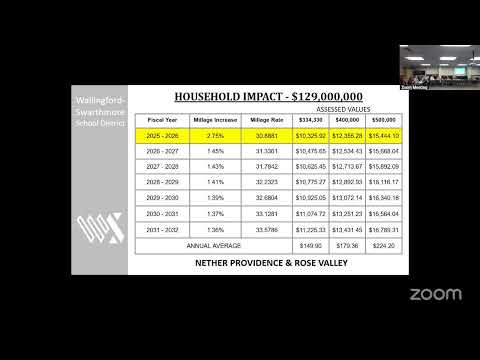
Two districtwide borrowing scenarios and the tax impact shown: Financial advisors (PFM and Raymond James) presented sample debt schedules keyed to the administration’s preliminary draw schedule. Under conservative assumptions the $164 million scenario would be borrowed in several issuances over multiple years; the advisors modeled roughly a phased annual mill increase in the mid-range of the plan. Their example: a multi‑year phase equating to roughly a 0.50‑mill annual addition over seven years (they described phase and contingency assumptions), which the advisors summarized as a total mill-equivalent requirement of about 3.39 mills over the 10‑year horizon to fund that larger scenario. For the smaller $129 million scenario they modeled roughly a 0.437‑mill annual increase across a similar multiyear phase, totaling about 2.62 mills across the horizon.
Household examples from the administration: The business office translated those model results into sample homeowner impacts using three assessed-value points. For the $164 million example the administration reported average annual tax-bill increases (spread over the modeled years) of about $194 for a property assessed near $334,000 (≈$16.25/month), $232 for $400,000 (≈$19.40/month), and $290 for $500,000 (≈$24.30/month). For the $129 million case the similar examples were roughly $150 (≈$12.55/month) at $334,000; $179 (≈$15/month) at $400,000; and $224 (≈$18.75/month) at $500,000.
Public questions and board concerns: Residents pressed about enrollment projections and whether the proposed additions (for example an expanded high-school capacity) matched projected student counts. One commenter asked why the high school expansion would lift capacity substantially above projected 2029–30 enrollment levels and asked for documentation tying proposed additions to demonstrated need. Board members asked for clearer numerical capacity and utilization charts the consultants could return with. Several speakers asked for a phased approach that prioritized essential systems and deferred discretionary items such as a turf field until the community had more input.
Next steps: The consultants said the plan is a living document: estimates and timing will change during schematic design and each project will have additional community engagement and design checkpoints. The advisors noted that interest-rate and market conditions will affect timing and that the district’s rating agencies will surveil outstanding debt as the district proceeds.
Ending: Committee members and members of the public asked the administration and consulting team for more granular enrollment, capacity and cost breakdowns at the next follow-up meeting so the board can weigh tradeoffs between addressing deferred building needs and the tax burden on residents.