
Secretary of State staff outline Oregon licensing directory, annual update requirement for agencies
Get AI-powered insights, summaries, and transcripts
Subscribe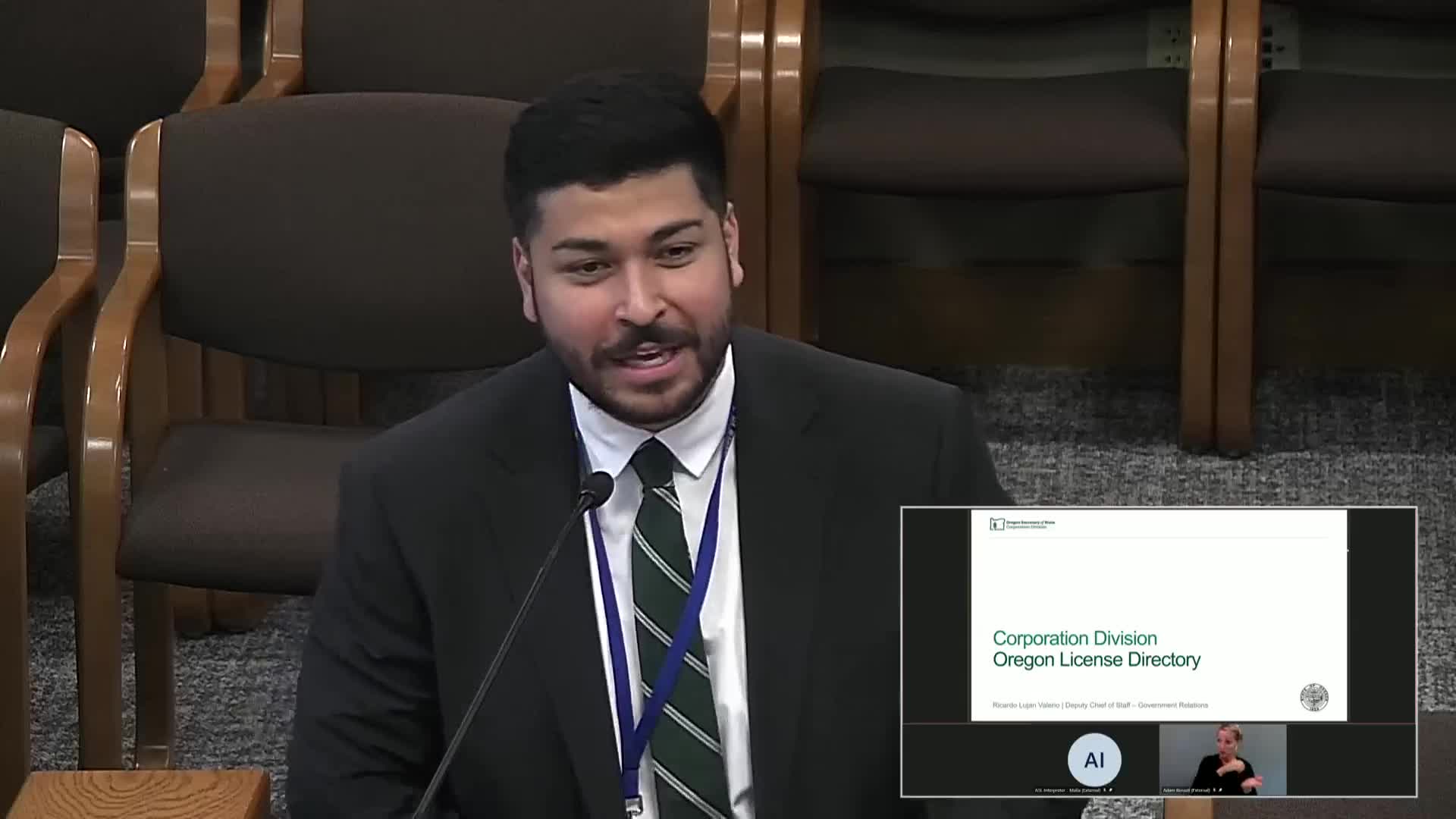
Summary
Deputy Chief of Staff Ricardo del Jamadillo told the Joint Committee on Information Management and Technology May 16 that the Oregon licensing directory is a free, centralized tool with more than 1,000 license types and that agencies must update listings annually between July 1 and Sept. 1 under 2013 legislation.
The Joint Committee on Information Management and Technology received an overview May 16 of the Oregon licensing directory, a centralized, public search tool maintained by the Secretary of State’s Corporations Division.
"The Oregon licensing directory is a free publicly accessible tool that allows anyone — business owners, agency staff, or the general public — to search for license permit and registration requirements across city, county, and state agencies," Ricardo del Jamadillo, deputy chief of staff for government relations at the Secretary of State’s office, told the committee.
Del Jamadillo said the directory includes more than 1,000 license types across industries — from childcare and food trucks to environmental permits and contractor licenses — and was formalized by the 2013 passage of House Bill 2643, which requires agencies that issue licenses, permits or registrations and that impose fees to report that information to the Secretary of State for inclusion in the centralized system.
Why it matters: the directory is intended to reduce the time small business owners spend researching requirements across multiple jurisdictions. The Corporations Division operates as a self‑funded entity that returns revenue to the general fund; Del Jamadillo said the division is projected to transfer $85,500,000 to the general fund in the 2025–27 biennium without raising filing fees.
Key details
- Public and agency functions: Public users can use keyword search and filters by city, county, agency and business category; agency staff have authenticated back‑end access to add, edit and maintain license entries.
- Statutory update window: Under the 2013 law cited in the presentation, agencies must review and update their entries annually between July 1 and Sept. 1, confirming processing times, fees and governing statutes or ordinances.
- Scope and limits: The directory provides summary information about license types, issuing agencies, processing times and contact points, but it does not provide individual license status, personal data of license holders or real‑time enforcement tracking.
- Phased development and next steps: Del Jamadillo said the current site reflects a phase‑one implementation with "certainly a lot of room for growth" and noted opportunities to improve sector‑specific guidance (for example, clarifying whether a food business needs county public‑health or Oregon Department of Agriculture licensing).
What committee members asked for
Representative Wynne tested the site on a phone and said it was useful but not yet precise for some users: "it's still not as exactly, where I'd like it to be from a user standpoint," Wynne said, citing examples such as restaurant licensing that can vary by county or agency. Committee members asked whether the Secretary of State could produce shareable materials and contact information for legislators to include in newsletters; Del Jamadillo and staff offered to provide materials and to share the small business ombudsman’s contact information.
Limits and safeguards
Del Jamadillo emphasized that the directory is a starting point and not a substitute for agency processes: it does not provide live status for individual license applications and does not display personal home addresses from licensing entries in the directory context. The Corporations Division maintains a separate business registration database that may include principal place-of-business information, Del Jamadillo said.