
Oregon officials review e-government portal program, vendor funding and data practices
Get AI-powered insights, summaries, and transcripts
Subscribe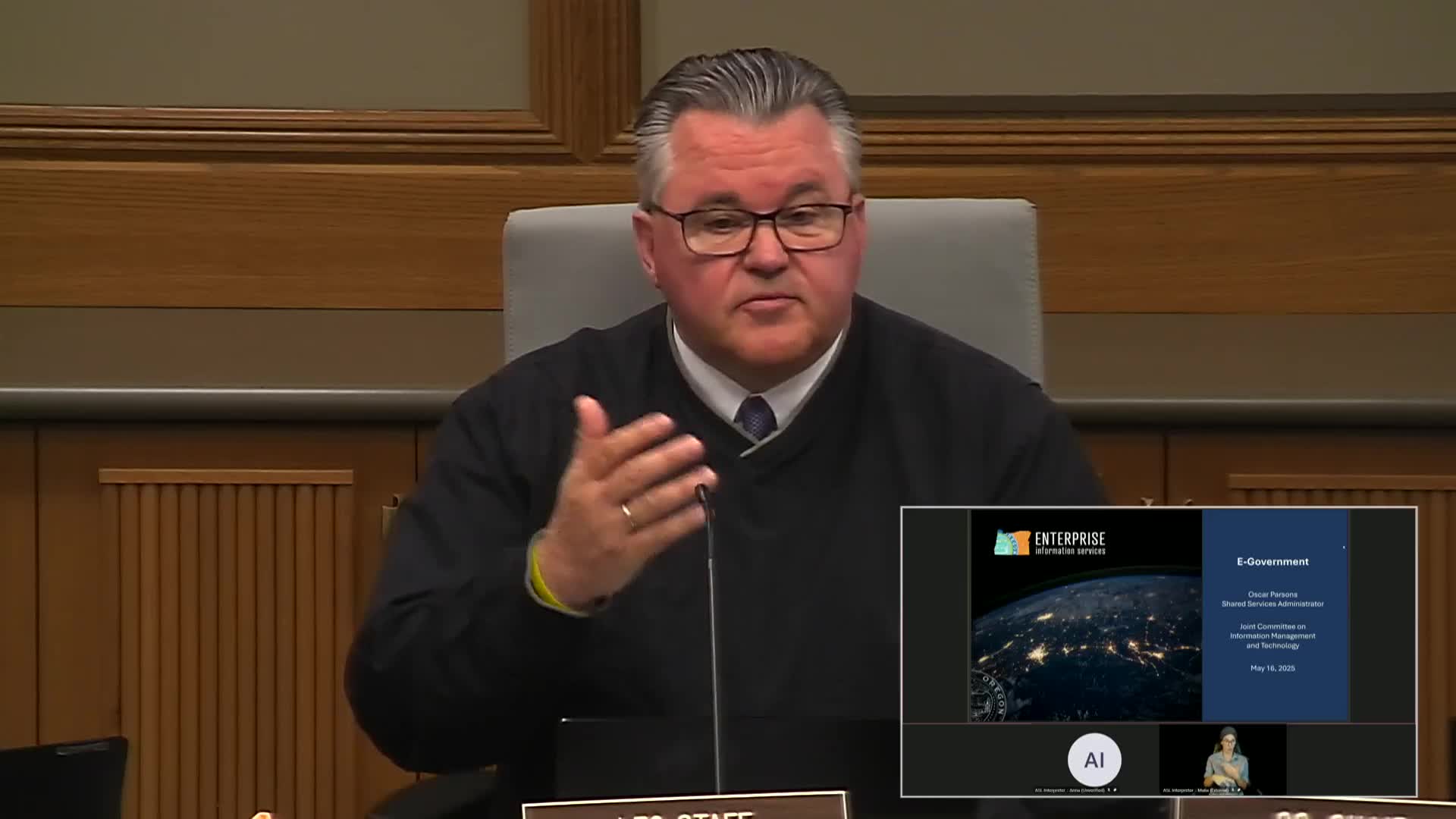
Summary
At a May 16 informational meeting, Department of Administrative Services staff described Oregon’s e-government portal program, the portal advisory board, vendor contract and fee model; lawmakers raised questions about the sale of DMV records used to fund the portal and about public data reuse.
The Joint Committee on Information Management and Technology heard an overview May 16 of Oregon’s e-government program, including the portal advisory board, the portal provider contract and how portal transactions are funded.
Oscar Parsons, shared services administrator in the Department of Administrative Services’ Office of Enterprise Information Services, told the committee the program is governed by a statutory advisory board and a vendor relationship that dates to 2011. "The core funding mechanism for, certainly Oregon and likely many of the other states, is, a partnership with, the state's transportation department, for the sale of, division of motor vehicle records," Parsons said, describing how sale of DMV records helps fund the portal.
The portal advisory board (referred to in the hearing as EPAB) is established by statute and, Parsons said, is a 13‑member body that advises the state chief information officer and the Department of Administrative Services on portal priorities, provider fees, contract terms and related rules. The state’s current portal provider is Tyler Oregon (Tyler Technologies acquired the original vendor, NIC USA, in 2021); Parsons said the existing agreement runs through 2025 and that the state has begun work on an extension.
Why it matters: the portal hosts hundreds of state services and accepts secure online payments for many of them; decisions about convenience and transaction fees affect whether the public or agency budgets absorb payment‑processing costs. Committee members raised concerns about the sale and commercial reuse of publicly available datasets used to fund the portal.
Most important details
- Program scope and vendor: Parsons said the e-government program (eGov) manages Oregon.gov vendor relationships and supports agencies using the statewide portal. Tyler Oregon provides the hosted solution; the contract was originally with NIC USA in 2011 and continues under Tyler through 2025.
- Funding model and fees: Parsons and committee members described a two-part funding picture: a base program funded in part by sale of DMV records and additional convenience or transaction fees negotiated per online transaction (for example, online vehicle registration or permit purchases). These negotiated convenience or transaction fees are reviewed with the portal advisory board.
- Portfolio and metrics: Parsons said the portal supported more than 300 state services as of December, with roughly 97% optimized for mobile; the program hosts about 134 agency websites, 26 customized applications and more than 100 services that accept secure online payments.
- Open data and reuse: eGov also hosts the state’s open data portal. Parsons acknowledged that publicly accessible datasets can be downloaded and reused — including by commercial entities — and said the office tracks access metrics. Senator Sollman said, "I have a fundamental problem with that," while Parsons noted the data are public and the portal provides centralized access.
- Accessibility and usability: the program uses automated tools (Siteimprove) and partnerships (including research with Portland State University) to monitor accessibility and usability. Parsons said language support has expanded: templates support 16 built‑in languages and now can be extended up to 249 languages from 108 the prior year.
What the committee discussed
Lawmakers asked for clarification about who sets convenience fees and how those fees affect agency budgets; Parsons and committee staff explained that negotiated transaction fees and processing fees vary by service and are addressed with agency staff and the portal advisory board. Several members suggested follow‑up work to examine data sales, DMV record access, and whether the state should publish additional guidance or limits on commercial reuse of publicly available datasets.
Limits and next steps
Parsons told the committee the portal advisory board has authority to advise on fees and portal terms but did not describe any pending changes to the portal contract. Committee leadership said staff would follow up on questions about data sales, the portal’s funding model and whether additional transparency or user‑facing features are warranted.