
Lee County officials propose $10,000–$50,000 fines, cease‑work authority for Mount Hill Road solar projects
Get AI-powered insights, summaries, and transcripts
Subscribe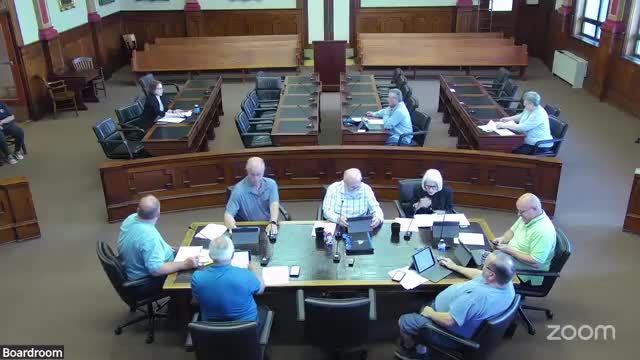
Summary
Lee County board members and staff discussed adding progressive financial penalties, stop‑work authority and a revocation process to special‑use permits for Mount Hill Road solar projects after contractors allegedly ignored permit conditions; the county also debated and questioned a proposed subsurface water testing requirement.
Lee County zoning staff and board members debated on May committee meetings whether to add progressive fines and stronger enforcement to special‑use permits for the Mount Hill Road solar projects after contractors who are not the petitioners reportedly violated permit conditions.
The proposed enforcement language would make the first violation a $10,000 fine, the second $25,000 and the third $50,000 plus filing a petition to revoke the special‑use permit, zoning officer Alice said. "The second violation, $25,000. And the third violation is $50,000 and a filing of a petition for revocation of special use permit," she said.
County officials said the penalties are meant to address a recurring problem in which the petitioner on file is not the contractor doing the physical work, leaving a gap between promised permit conditions and on‑the‑ground construction. "What I'm finding out is that the companies that are petitioning are not the companies that are building these projects," Alice said, and that has led to repeated violations.
Why it matters: Board members said the county has had instances where companies continued work after warnings and that stronger, clearly spelled‑out penalties — and the ability to stop work — could give the county more leverage to enforce permit conditions and protect neighbors and public safety.
During discussion board members proposed that projects cease work until fines are paid, with suggested cure periods ranging from three business days to 30 days depending on the severity and whether due process or an appeal is requested. "I think stopping it . . . until the fine is paid. Otherwise, you don't have any care for them," said Nancy Naylor.
County staff and board members also discussed enforcement mechanics: who serves notices, how to document violations that occur on weekends and whether law enforcement could serve cease‑and‑desist orders. Charlie (county staff) and others said the zoning officer would investigate, gather evidence and could have a cease‑and‑desist served by law enforcement if needed.
Board members asked that any enforcement procedure include an appeal or hearing process so a company can contest the penalty. "If you have a $50,000 fine and they disagree with it . . . there needs to be that due process in place," one board member said.
Separately, the committee reviewed a recommended Zoning Board of Appeals condition calling for a subsurface water (well) test before construction and every other year thereafter, with results reported to the Lee County Health Department. Zoning staff objected. "There is no well associated with either project, Mount Hill north or south. So I don't understand what well is being studied," Alice said, calling the proposal "vague" and an "uncontrolled study" that would be difficult to enforce and unlikely to yield usable cause‑and‑effect results.
Board members agreed to take the proposed enforcement fines and the well‑testing question back for staff to draft clearer language and procedures. Alice said she would work with Stephanie and consult board members and that the proposed enforcement condition could be incorporated into the resolution heading to the county board next week. No formal vote on fines or the well‑testing condition was taken at the committee meeting.
Next steps: Staff will draft enforceable language and procedures, including options for payment timelines, an appeal process and service mechanisms; the draft is expected to be circulated to board members in advance of the county board meeting.