
House committee hears explanation of Rygate amendment, timeline for PUC rate review and efficiency upgrades
Get AI-powered insights, summaries, and transcripts
Subscribe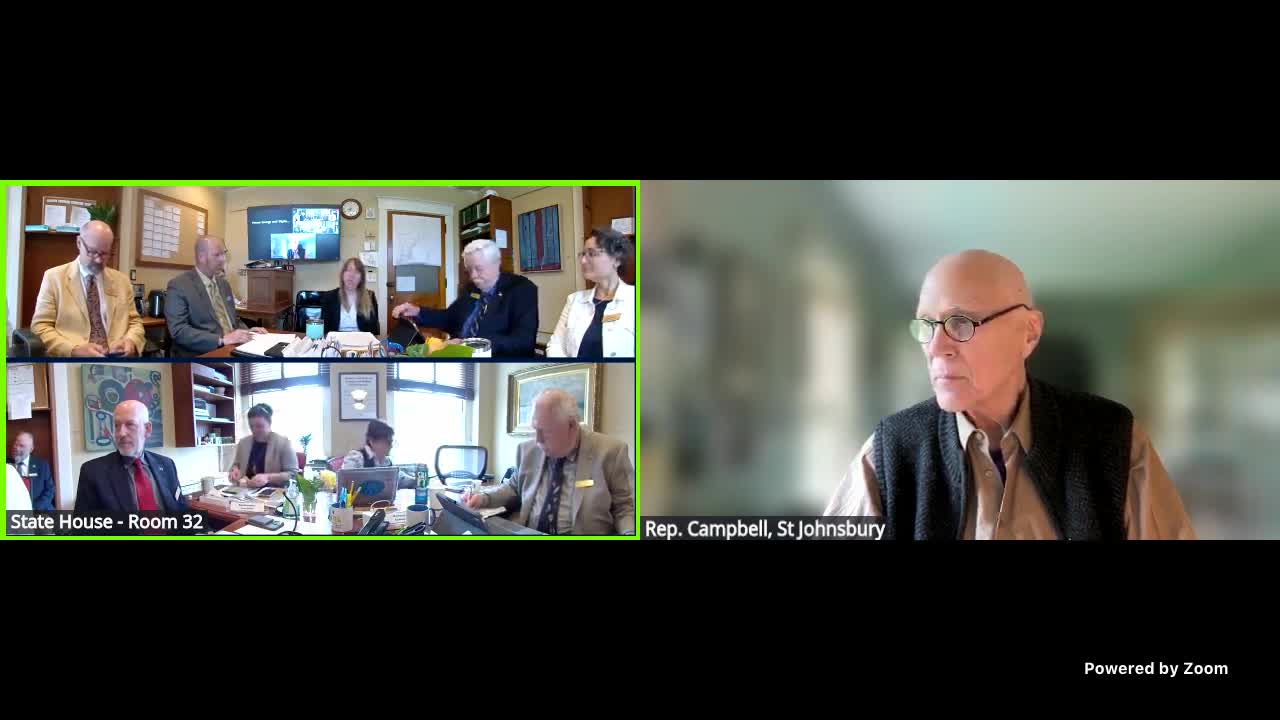
Summary
Members of the House Energy and Digital Infrastructure committee reviewed proposed amendments affecting Rygate, a statewide biomass baseload plant, including shifted deadlines for efficiency upgrades, a delayed Public Utility Commission rate determination and possible early termination of purchase obligations if milestones are missed.
The House Energy and Digital Infrastructure committee on May 16 reviewed language in a Senate amendment to H.319 that would change deadlines tied to the Rygate biomass power plant’s statutory power‑purchase arrangement and delay when the Public Utility Commission must set a new rate for the plant.
The discussion matters because state law currently requires utilities (other than Burlington Electric Department’s McNeil plant) to purchase a pro rata share of Rygate’s output at a rate set under a statutory formula; the amendment would push back key construction and verification deadlines and move the earliest PUC rate determination into 2028 while keeping the contract term ending in 2032.
Representative Kathleen James, who led the committee discussion, described Rygate as “a biomass facility that burns wood products to generate electricity” and said the statute at issue sets a special standard‑offer and an avoided‑cost formula for the plant. She said the 2012 rate has been repeatedly extended and that the amendment would change several statutory dates that govern required efficiency upgrades and the timing of a new PUC rate determination.
Under the language the committee reviewed, the plant owner must increase the facility’s overall efficiency by at least 50 percent relative to a 12‑year baseline period preceding July 1, 2022, by following staged requirements in subsection k. Key deadlines discussed in the meeting include an initial contract and engineering‑certification filing originally due on or before Oct. 1, 2025 (the draft would move that date forward by one year); a later certification that major components have been manufactured and plans completed; and a departmental investigation and recommendation due on or before Sept. 1, 2026 (which in the draft becomes 2027).
Committee members were repeatedly warned in discussion that missing certain near‑term filings would have an automatic consequence under current statute: if the specified contract or certification filings are not made by the statutory deadline, the obligation for utilities to purchase the plant’s pro rata share could cease on Nov. 1 of the applicable year. Representative James told members that subsection text sets multiple "drop‑dead" dates at which the statutory purchase obligation could end if the efficiency steps are not completed.
Ellen Tchaikovsky, legislative counsel, explained how the PUC rate determination interacts with that timeline. "When the PUC sets rates generally for any type of electricity, they base that rate on the avoided cost," she said, noting that federal law constrains what the PUC may consider and that the statute expressly bars the PUC from including capital and operating costs of the efficiency project when calculating avoided cost under subsection e. The amendment discussed would move the earliest date for the PUC to determine a new rate to Nov. 1, 2028; the statute would still limit the plant’s rate protection through 2032.
Members asked for technical clarifications about what constitutes compliance with intermediate milestones (for example, whether delivery of manufactured main components and completed construction plans is sufficient evidence of progress). Representative Scott urged language that would explicitly require that construction of the efficiency improvements be completed before the Department of Public Service issues its recommendation. Other members pressed for independent data on the plant’s current thermal‑to‑electric efficiency; the transcript includes an un‑attributed remark that the plant’s efficiency was "about 23 percent," and committee members asked PUC and DPS to provide verified efficiency figures.
The committee also discussed ancillary materials the body has already requested: a March 2022 contingency‑scenario economic report from the Agency of Commerce and Community Development (ACCD) in consultation with the Agency of Natural Resources and the Department of Forests, Parks and Recreation; a 2023 report on the plant’s decommissioning fund; and periodic reporting on wood fuel prices and contracts. Representative Brett Campbell asked specifically about the potential economic impacts on loggers and the regional forestry sector if the plant were to close; members agreed those reports are material to any decision about changes to the statute.
No formal vote was taken in the meeting. Committee staff were directed to secure witnesses for next‑week hearings, including representatives from Rygate (the plant), the Public Utility Commission, the Department of Public Service and the Department of Forests, Parks and Recreation, and to circulate the prior reports cited in committee discussion. Representative James said the committee has some scheduling flexibility and that Rygate and other witnesses would be asked to appear during the coming week so the panel can take a straw poll and consider amendments before floor action.
Committee members emphasized that the amendment would change deadlines but not extend the statutory end date for the plant’s rate protections beyond 2032; they also noted the PUC’s avoided‑cost rules and federal constraints on rate setting. Members signaled interest in a clear definition of the construction and verification milestones, independent efficiency measurements, and updated economic impact analysis before committing to a position.
For now, the committee plans to hear parties next week and then decide whether to propose amendments or take a straw poll before the bill moves toward the floor. The committee chair asked staff to post the referenced reports and to coordinate witness schedules so legislators have the factual material needed to evaluate the amended language.