Get Full Government Meeting Transcripts, Videos, & Alerts Forever!
Get email alerts on the Fire Department Budget topic
No spam. Unsubscribe anytime.
Boston Fire Department proposes modest FY26 budget increase as 85 SAFER-funded firefighters move to city payroll
Summary
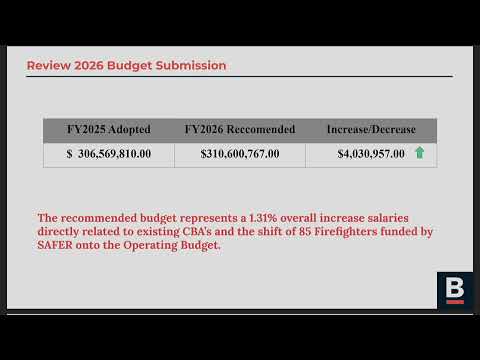
At a May 13 hearing, Boston Fire Department leaders told the City Council Committee on Ways and Means that the FY26 budget they submitted recommends a $4 million increase, driven mainly by collective bargaining raises and the absorption of 85 positions previously funded by a SAFER grant.
Boston Fire Department leaders told the Boston City Council Committee on Ways and Means on May 13 that the department’s FY26 operating budget packet recommends $310,600,767, an increase over FY25 primarily tied to collective bargaining and the transfer of 85 grant-funded firefighters to the city payroll.
The increase matters because it shifts recurring personnel costs into the city operating budget and leaves less one-time funding for nonpersonnel needs. Deputy Commissioner for Administration and Finance Kevin Coyne said the overall increase in salaries is related to labor agreements and the post‑grant absorption of positions.
Kevin Coyne, deputy commissioner for administration and finance, told councilors the recommended FY26 total “represents a 1.31 overall increase in salaries and most of that increase is directly related to collective bargaining agreements.” Coyne also said 85 firefighters who had been paid through a FEMA SAFER grant transitioned to the city payroll effective April 1 after the grant expired in March.
Coyne walked the committee through line‑item shifts in the department’s submission, noting reductions in supplies and contracted services and increases tied to debt service for lease‑purchase agreements and added lease space for a special operations command center on Rivermore Street. “We anticipate that we're on track to spend almost everything that is listed as available,” he said when discussing FY25 spending through March 31.
Panelists told the committee the department expects to use about $1.7 million in lease‑purchase funding for apparatus replacement and identified two targeted units for this cycle: a lighting unit (about $500,000) and a specialty hazmat unit. Council members pressed staff on whether cuts in some lines — including a $619,000 reduction in supplies and a roughly $193,000 decrease in contracted services — would affect operations; Coyne said the department is prepared to absorb decreases but that the implications will become clearer as the fiscal year closes.
The presentation did not include votes or formal actions; the hearing was a committee budget review and information session. The council will continue budget hearings through June and take additional testimony, both in‑person and virtually, before finalizing recommendations.