Get Full Government Meeting Transcripts, Videos, & Alerts Forever!
Get email alerts on the State Budget topic
No spam. Unsubscribe anytime.
Oklahoma leaders unveil budget agreement with tax cut, education and health investments and tort reforms
Summary
Oklahoma’s governor and top legislative leaders announced a negotiated budget agreement that includes a quarter‑point cut to the top income‑tax rate, one‑time investments in university health and veterinary facilities and other capital projects, changes to teacher pay and one day of school calendar time, and a tort‑reform package designed to limit large non‑economic awards.
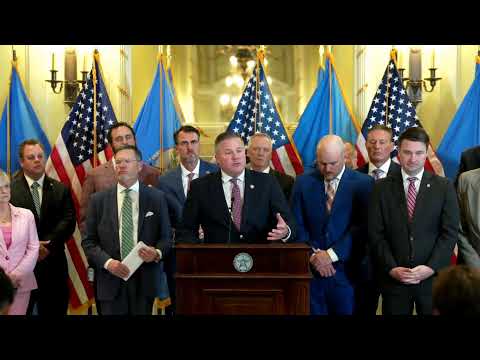
Oklahoma’s governor, Senate Pro Tem Paxton and Speaker Kyle Hilbert onstage with House and Senate appropriations chairs announced a bipartisan budget agreement that includes a quarter‑point reduction to the top individual income‑tax rate, targeted one‑time capital investments, changes to teacher pay and the academic calendar, and a tort‑reform package intended to limit large non‑economic awards.
The leaders said the package will cut the top income‑tax rate from 4.75% to about 4.5% and eliminate the lowest three brackets so no income tax would be paid until about $8,000 in annual income; they described that change as a quarter‑point top‑rate cut and part of a path toward a flatter tax structure. "So the agreement was a quarter point top cut on the top rate and then doing away with the bottom 3 brackets," the governor said.
The agreement also includes one‑time, large capital investments leaders described as "generational": $200,000,000 for an Oklahoma University pediatric heart hospital; $250,000,000 for Oklahoma State University’s veterinary school; an approximately $312,000,000 purchase of the Lawton correctional facility to bring it under Department of Corrections control; and $41,600,000 for Oklahoma National Guard facilities and deferred maintenance. The governor said he signed "Senate Bill 4 80, which will allow companies to build power generation behind the meter." That bill was described as enabling industrial customers to install on‑site generation.
Appropriations Chair Trey Caldwell and Senate Appropriations Chair Chuck Hall said the package was negotiated among the governor, the House and the Senate and reflects a combination of savings and targeted investments. "Behind every dollar that we appropriate, there's a person," Hall said, noting the state still holds roughly $3.5 billion in savings.
Education provisions described by leaders include a one‑time addition of instructional time: $25,000,000 placed into the common education funding formula will trigger a one‑time increase of the statutory minimum school year from 165 to 166 days (or roughly an additional 6.5 hours), and the agreement would extend step raises for teachers beyond year 25 to increase pay for experienced educators. Leaders said this iteration differs from a previous House floor version that would have added a day permanently for each $25,000,000 increment. "This is a one time opportunity," Caldwell said.
Mental‑health funding was discussed as still under negotiation; leaders cited a supplemental figure of about $27,000,000 for fiscal 2025 as the current working number and said teams were finalizing the 2026 figures. The governor and chairs said they expect additional review early in the next session and noted work by the legislative auditor and LOFT on long‑term solutions related to the consent decree and Title 19 maintenance‑of‑effort spending.
Tort reform measures were described as a finalized package after years of negotiation. Provisions leaders previewed include a cap on non‑economic damages, reforms to prevent workers’‑compensation claim stacking, and changes to the Governmental Tort Claims Act intended to limit what leaders called “jackpot awards” against municipalities. The governor said some reforms respond to a court interpretation that allowed multiple per‑person claims in a single household after sewage backups; he said an insurer’s exhaustion of coverage had left municipalities exposed and that reforms would preserve compensation for injured parties while limiting outsized awards.
Leaders addressed revenue impact and competitiveness. The governor said the quarter‑point top‑rate cut would reduce next fiscal‑year revenue by about $120,000,000 and removing the three bottom brackets would reduce revenue by roughly $40,000,000, figures he attributed to the tax commission. They framed the cuts as keeping Oklahoma competitive with neighboring states and as returning money to residents’ pockets.
Several other items were noted as part of the session’s work: creation of business courts, steps to promote more electricity generation including the behind‑the‑meter authority, and continued deferred‑maintenance funding for state facilities. The governor and legislators emphasized the package will be presented to caucuses for votes before final legislative action.
Discussion versus decision: leaders said the governor has already signed Senate Bill 480 (behind‑the‑meter generation). Most other elements described—the budget agreement, the tort‑reform bill text, education language, and mental‑health supplemental figures—were presented as negotiated agreements or working figures to be taken to each chamber, not as final enacted law at the time of the news conference.
Looking ahead, officials said they will publish the detailed portal for line‑item review after caucus briefings and continue technical work on mental‑health supplemental amounts and final drafting of tort‑reform language. "We worked very hard to get that final version," Senate leadership said of tort reform.