Get email alerts on the Parking Reform Code Amendments topic
No spam. Unsubscribe anytime.
Troutdale planning commission recommends code amendments implementing state parking reforms, forwards package to council
Summary
The Planning Commission reviewed a city-sponsored package to amend Troutdale’s Development Code and Municipal Code to implement Oregon’s ‘climate‑friendly equitable communities’ parking reforms. After extensive public deliberation and several wording edits, the commission voted to forward the amended package to City Council for final action.
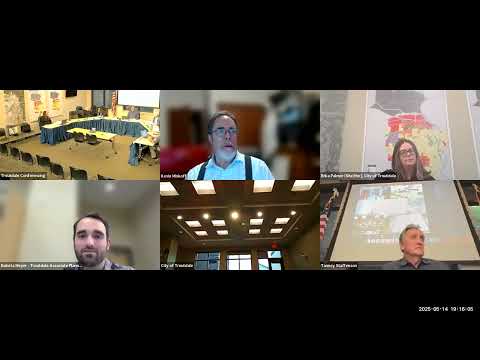
The Troutdale Planning Commission on Wednesday reviewed a city-sponsored package of Development Code and Municipal Code amendments intended to bring the city into compliance with Oregon’s parking‑reform mandates and the state’s Climate‑Friendly and Equitable Communities program, and voted to recommend forwarding the amended package to City Council.
Erica Palmer, Troutdale’s community development director, told commissioners the package would amend Troutdale Development Code chapters 6, 8 and 9 and Troutdale Municipal Code Titles 3 and 5 to reflect statewide parking reforms and related local policy choices. “These new rules primarily are around parking reform,” Palmer said, explaining the state rules aim to reduce climate pollution, increase housing flexibility and expand transportation options.
Under the state requirements discussed at the hearing, cities within the Portland metropolitan area and cities with populations over 50,000 must adopt changes that include reduced parking minimums for many uses, requirements for electrical-vehicle (EV) conduit in new multifamily and nonresidential development (40% of spaces for new multifamily; 20% for nonresidential), allowances for shared and off‑site parking within 2,000 feet, and higher tree‑canopy or solar coverage on new parking lots larger than one half‑acre. The staff presentation also highlighted options from “parking reform B,” a set of policy choices that cities must select from to implement locally. Palmer said the city’s deadline to adopt both phases of parking reform into local code is June 30, 2025, though Troutdale had received an extension from the Department of Land Conservation and Development (DLCD).
Commissioners spent more than an hour questioning staff and suggesting textual edits to findings and code language. Key suggested edits the commission recommended to staff included: removing the word “new” from references to a 10% tax on commercial parking-lot revenue; revising language that implied amendments would create development incentives to build off‑street parking; rewording a parking‑plan requirement to read that a parking plan shall “maximize on‑street parking”; and changing qualifying language in the findings from “will contribute to a healthier environment” to more cautious wording such as “may.”
Several commissioners pressed staff on practical implications for downtown Troutdale and expressed concern that reduced parking minimums might harm downtown businesses that rely on short, convenient customer trips by car. Commissioner Allen argued that for quick, weather-sensitive trips such as buying coffee or groceries, customers are unlikely to accept long transit waits or unfavorable weather. Commissioner Stephenson said the commission had been placed “between a rock and a hard place” by statewide mandates but thanked staff for seeking locally tailored and less painful options.
The commission also discussed technical mapping decisions and measurement methods used to identify areas exempt from parking minimums near high‑frequency transit. Staff explained the city used walking-distance buffers rather than straight-line “as‑the‑crow‑flies” buffers to limit the number of parcels affected on the map that will be Exhibit E in the staff report.
After discussion the commission moved to recommend forwarding case file LU00082025—the Climate‑Friendly Equitable Communities amendments—to City Council as amended. The motion passed on a roll call with Commissioners McCall, Birkett, Wilcock, Chair Stephenson and Commissioner Allen recorded as voting in favor. The commission also discussed submitting a comment for the record noting that, since Troutdale adopted its 2020 Housing Needs Analysis, the city has produced over 200 housing units and that the commission is concerned about potential inconsistencies between the statewide rules and local conditions on the ground.
Palmer said the next steps are a City Council introduction on June 10 and a possible council adoption hearing on June 24. Staff also plans additional public engagement on downtown parking management this summer, including an online survey and in‑person outreach.
No ordinance was adopted at the Planning Commission meeting; the commission’s recommendation will be forwarded to the City Council for its final decision.
AI generated
The text on this page is AI generated. Summaries, highlights, analysis, and video transcripts are all produced from the original source material.
AI can make mistakes, so if you spot one, and we will fix it for everyone.
Note: the source content is unaltered by us. Any content source we link to, be it a video, an audio recording, or a document, is presented exactly as its publisher released it. That publisher is usually a government body, sometimes an individual official or another organisation.