Get Full Government Meeting Transcripts, Videos, & Alerts Forever!
Get email alerts on the Spdi Regulation topic
No spam. Unsubscribe anytime.
Wyoming Speedy banks report growth, urge federal reciprocity; committee considers conversion language and easing contingency account rule
Summary
Speedy (SBDI) leaders and state regulators updated the Select Committee on banking charters, conversion drafts, and operational hurdles; bankers urged federal recognition of Wyoming’s framework, and the banking commissioner recommended repealing the statutory contingency account requirement and clarifying certificate-of-authority timelines.
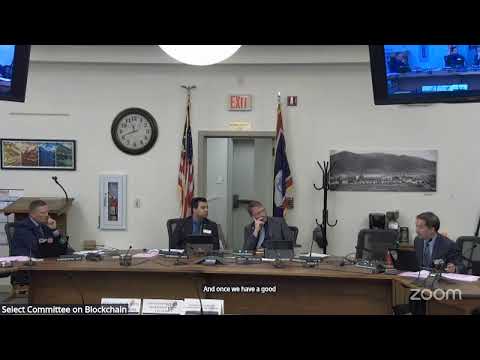
Wyoming’s special purpose depository institutions (SPDIs or “speedies”) told the Select Committee on Blockchain, Financial Technology and Digital Innovation Technology on Friday that business is expanding but that federal regulatory changes and operational frictions are creating uncertainty.
Bankwise CEO Julie Fellows said deals close weekly and asked the state to help educate industry partners about Wyoming’s decade of regulatory work for speedies, to pursue reciprocity with other states and to engage at the federal level so speedies are included in federal legislation and supervisory frameworks. “Wyoming’s regulatory framework and oversight is the biggest competitive advantage Speedies have,” Fellows said.
Custodia Bank founder Caitlin Long described two product milestones: the launch of tokenized bank deposits issued on a permissionless blockchain and a first cross-border corporate payment using that tokenized deposit. Long said Custodia returned $74.4 million of customer funds during earlier “debanking” episodes and that the firm’s 100% reserve business model performed well under stress. She urged continuity of federal engagement to protect state gains and warned that Federal Reserve actions have in the past constrained Wyoming SPDIs’ market position.
Kraken Financial CEO Trevor Rutar said Kraken has expanded custody services, completed proof-of-reserves and financial audits, and is working on a forthcoming announcement with Senator Lummis. Commercy and other depositary firms asked the committee for a formal SPDI advisory council and a clearer road map for federal integration to reduce investor uncertainty.
Statutory work under consideration: committee staff presented two related draft bills — 26 LSO 13 (allowing an SPDI to convert to a state bank) and 26 LSO 14 (allowing a state bank to convert to an SPDI). State Banking Commissioner Jeremiah Bishop and committee counsel discussed combining the drafts into one conversion bill. Bishop supported adding conversion language but identified policy issues to resolve, including capital treatment, whether FDIC deposit insurance would be required before commencing business after conversion, and how lending authorities would change after conversion.
Contingency account repeal and certificate-of-authority timing: counsel and the commissioner discussed revising Wyo. Stat. 13-12-106, the provision that requires SPDIs to maintain a contingency account equal to two percent of deposits once in operation three years. Commissioner Bishop said the requirement has proved cumbersome and recommended repealing 13-12-106(a) and (b). The committee asked staff and stakeholders to draft a repeal. Bishop also proposed clearer, enforceable timelines for the charter-to-operations “certificate of authority” step, including proof-of-paid-in capital and a deadline to commence business (commission suggested 12–18 months with a limited extension), to avoid multi-year “purgatory” where chartered entities do not open.
Capital and conversion mechanics: Bishop and counsel discussed how converted institutions would meet traditional bank capital standards (the statutory minimum for a De Novo state bank includes paid-in capital stock, surplus and operating expenses) and whether converted SPDIs should be required to meet the same initial capitalization as De Novo banks. The commissioner proposed allowing case-by-case determinations rather than a one-size-fits-all de novo requirement.
Committee direction: members agreed to combine the conversion drafts into one bill, ask the commissioner and LSO to prepare language addressing capital and certificate-of-authority timelines, and to draft a straightforward repeal of the statutory contingency account (13-12-106). The Select Committee also authorized a working group — led by Representative Tim Filer with participation from banking stakeholders — to refine the certificate-of-authority timelines and other operational changes.
What didn’t happen: The committee did not take final votes on the conversion bills or the contingency-account repeal during the hearing. No changes were enacted; members asked staff and regulators to prepare amended drafts for future meetings.