Get Full Government Meeting Transcripts, Videos, & Alerts Forever!
Get email alerts on the Artificial Intelligence Governance topic
No spam. Unsubscribe anytime.
Wyoming committee weighs state approaches to AI governance, MRO certification and risks from autonomous agents
Summary
The Select Committee reviewed other states' AI laws, heard a model for a multi‑stakeholder regulatory organization (California SB 813), and received expert testimony on autonomous AI agents, safety, provenance and economic impacts. Members asked staff to share the California bill and to continue studying 'human‑in‑the‑loop' and liability options.
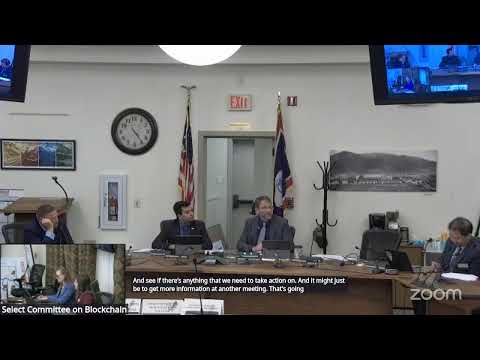
The Select Committee on Blockchain, Financial Technology and Digital Innovation Technology met May 20 in Jackson to review state approaches to artificial intelligence governance and to begin a discussion of liability, transparency and autonomous AI agents.
Clarissa Nord, attorney with the Legislative Service Office, told the committee that "AI systems are machine based technologies that generate predictions, decisions, or outputs that can affect real or virtual environments," and summarized recent state activity. She told members that California, Colorado and Utah each adopted different AI frameworks in the prior year — California focusing on transparency for generative AI (including requirements to disclose training datasets by 2026), Colorado concentrating on so‑called "high risk" systems in areas such as employment and housing, and Utah creating an AI learning lab and limited regulatory relief for testing.
Daza Greenwood, a researcher who said he runs a lab at MIT called law.mit.edu, recommended lawmakers study California Senate Bill 813 as a possible "third way" between little regulation and broad mandates. Greenwood described SB 813 as creating a voluntary multi‑stakeholder regulatory organization (an MRO) that could certify models against minimum safety and disclosure standards. "When such a model or application is certified, then it receives a kind of provisional safe harbor for liability, a rebuttable presumption," Greenwood said, describing how certification would create a presumption that a provider had exercised reasonable care in tort claims unless the plaintiff could introduce evidence to rebut it.
Greenwood also described rapid commercial deployment of autonomous AI agents — software that accepts goals, plans sequences of steps, and uses APIs and tools to act — and said such agents are being used now in legal drafting, contract review and commercial shopping workflows. He said agent systems can substitute for human labor in some tasks and forecasted substantial economic shifts: "We get like a 3, 4 or 5% boost in our GDP by 02/1930 or earlier," Greenwood said (transcript: discussion of plausible economic uplift and timing). He urged policymakers to plan for both the productivity gains and associated labor disruption.
Committee members asked whether aggressive state rules would push industry out of a state; Nord said she had not seen evidence of companies avoiding states such as Colorado but offered to follow up. Members asked Greenwood about security and provenance risks for models from foreign sources such as DeepSeek; Greenwood recommended a cautious, use‑case‑by‑use‑case approach and noted that open‑source models can be inspected but may also raise replication and integrity questions.
The committee did not adopt an AI bill at this meeting but agreed to receive a copy of California SB 813 once finalized and to continue study of human‑in‑the‑loop requirements, liability frameworks and certification or sandbox models.
Why it matters: committee members said they intend to "regulate to enable" rather than to restrict, seeking bright lines that protect consumers and civil rights while preserving innovation and data center investment.
What’s next: staff was asked to circulate SB 813 to members when it is finalized and to schedule further briefings; staff and members signaled interest in studying certification/safe‑harbor models, authenticated delegation for agents, and how to draft narrowly tailored rules for high‑risk decision making without unnecessarily hindering useful deployments.