Get Full Government Meeting Transcripts, Videos, & Alerts Forever!
Get email alerts on the Data Privacy topic
No spam. Unsubscribe anytime.
Wyoming committee revisits bill limiting government transfer of personal data amid title-records, security concerns
Summary
A Select Committee hearing on a bill draft (26 LSO 12) to restrict government entities from transferring personal data drew detailed testimony from title industry counsel, consumer advocates and technologists about access for title companies, public-records conflicts and data security measures including retention and destruction rules.
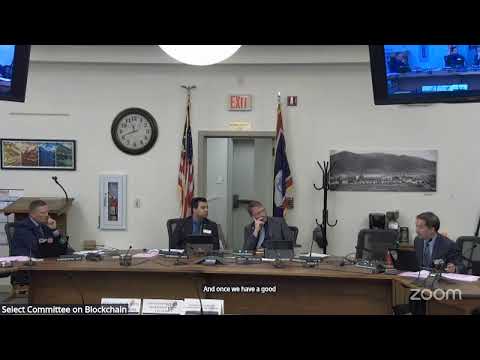
The Select Committee on Blockchain, Financial Technology and Digital Innovation Technology heard detailed testimony Friday on 26 LSO 12, a bill draft that would bar government entities from purchasing, selling, trading or transferring personal data without a person’s express written consent, with limited exceptions for other government entities, contractors, law, and transfers allowed by HIPAA or FERPA.
Committee staff attorney Talise Hansen told members the draft also would let Wyoming residents request copies of personal data held by government entities, object to accuracy or relevance, require agencies to adopt policies on collection, retention and security, and prohibit collection of more data than necessary. The draft would limit retention to three years unless a written policy with justification allows longer storage.
Why it matters: the bill attempts to put new, statutory limits on how state and local governments handle personally identifiable information as digital systems proliferate. Supporters framed it as a privacy baseline; several witnesses said implementation details will decide whether public functions such as land-title research or routine public-records requests are disrupted.
The American Title Agency’s general counsel, William C. Lubin of Casper, urged the committee to add carve-outs or clarifying language for licensed title-insurance companies and county clerk electronic access. “I think the bill is very well intentioned,” Lubin said, but warned that the draft’s undefined term “transfer” could be read by some county clerks to cut off the electronic interfaces title companies use to build title plants and process loans. Lubin also flagged conflicts with the Wyoming Public Records Act, saying the draft could make publicly recorded documents effectively confidential and complicate litigation that relies on historic records, including quiet-title actions where the referenced person may be deceased.
Committee members and staff said they had discussed the title-records issue with several county clerks and that clerks believed the Public Records Act would allow continued electronic access for title work. The bill includes a case-by-case exception allowing an elected governing official to grant an exception for up to two years, and the committee noted that a clerk could publish such a waiver if access were needed.
Consumer testimony emphasized data-security and accountability. Carrie Aghay, a Buffalo resident and retired geoscientist, called the draft “a valiant first effort” and urged stronger language on secure destruction practices, clearer assurances that agencies actually erase or return data when it’s no longer needed, and stronger enforcement or remedies for people harmed by mishandled data. Aghay warned the committee to consider downstream uses of behavioral, utility and other data by algorithmic systems.
Technologists raised implementation questions. Brendon Maher, who has worked on digital-identity efforts, told the committee that the draft’s requirement to “destroy” transferred personal data could be impractical where records are referenced on immutable ledgers or blockchains; he urged language that permits revocation of access or key destruction and suggested future amendments to enable cryptographic approaches such as zero-knowledge proofs for verification without disclosure.
Public comments also ranged into related security topics. Reid Raisner, a private-sector commenter who discussed Wyoming’s proposed stable token and potential integrations with large social platforms, told the committee that state-backed digital financial infrastructure will require stronger encryption, post-quantum readiness and active AI monitoring to protect users’ personal and transactional data.
Committee direction and next steps: Members signaled they want more stakeholder feedback. Committee leaders said they would take the bill back for further work and more public comment rather than moving to immediate approval, citing remaining open questions about public-records interaction, clarity on the term “transfer,” and operational language on retention and destruction.
What didn’t happen: The committee did not vote on the draft. No formal carve-out language was adopted at the hearing; members asked staff and stakeholders to refine the bill and return it for further consideration.
Closing note: The draft as presented tries to balance two competing needs—reducing nonconsensual commercial uses of personally identifiable information and preserving everyday public functions that rely on access to records. Committee members repeatedly asked for concrete examples of things that must stay publicly available to ensure the bill does not unintentionally impede public services such as title work or routine access under the Wyoming Public Records Act.