Get Full Government Meeting Transcripts, Videos, & Alerts Forever!
Get email alerts on the Climate Resilience topic
No spam. Unsubscribe anytime.
Tequesta utilities director presents DEP‑prescribed coastal vulnerability assessment, outlines grant‑funded priorities
Summary
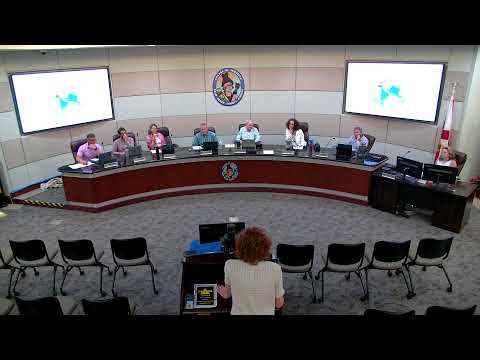
Marjorie Craig, Utilities Director for the Village of Tequesta, presented the village’s FDEP‑prescribed vulnerability assessment at the Environmental Advisory Committee meeting on May 14, 2025, citing grant funding and mapped inundation risks that prioritize generator elevation, stormwater pipelining and a Dover Ditch living‑shoreline project.
Marjorie Craig, Utilities Director for the Village of Tequesta, presented the village’s Florida Department of Environmental Protection (FDEP) vulnerability assessment at the May 14, 2025 Environmental Advisory Committee meeting, saying the work was done to “help assess what’s vulnerable in our community” and to position the village for grant funding.
Craig told the committee the project was financed initially with a $95,000 FDEP grant and that she later secured an additional $50,000 grant to fill data gaps: “we received a grant originally of $95,000,” and then applied for the extra funds to capture stormwater structure survey data used in modeling scenarios.
The assessment follows DEP’s prescribed methodology and combined inventorying critical assets, topography and GIS layers, inundation modeling (storm surge and rainfall‑induced flooding), exposure and sensitivity analyses, and two public meetings. Craig described the DEP guidance as a technical ‘‘recipe book’’ for assembling layers and flood scenarios and said the village finalized a preliminary adaptation plan after sensitivity testing.
Key findings and priorities include three mapped focus areas where critical assets show elevated exposure; the water treatment plant, while “pretty resilient,” needs hardening; generators at Village Hall and the Public Safety Building should be raised; lift stations that serve portions of the village are owned by the Loxahatchee River Environmental Control District and are outside direct village control; and downtown stormwater conveyance, swale restoration and pipelining were identified as near‑term priorities.
Craig gave several quantitative details from the assessment and the village’s stormwater inventory: about 12.6 miles of buried culverts, roughly a half‑mile of Dover Ditch, four pollutant separators, three water‑level control structures, and a pipelining program intended to extend the life of aging pipes by roughly 20 years. She said the village has identified flapper (check) valves for specific locations with a preliminary cost estimate of about $223,000 and that the Dover Ditch living‑shoreline project is estimated at $315,000; she noted the project received 50% legislative funding and said the village’s stated share was 60% while the town of Jupiter’s share was 40%.
On next steps Craig said the Resilient Florida grant program recurs annually (typically with a September deadline), offers up to 50% funding for qualifying projects, and that some categories (for example pipelining) are not eligible under certain grant tracks. She invited committee members to review maps and the full assessment on the village website and said staff will pursue coordination with regional partners and the Loxahatchee River organizations to address shared assets.
Committee members asked technical and programmatic questions—about whether the study area included assets outside village limits, about the scope of the Dover Ditch work and its bid schedule, about swale restoration and how it would affect private property, and about coordination with the Loxahatchee River district on lift stations. Craig said Dover Ditch was out to bid with an expected award about 30 days after bidding and a likely construction start before the end of the year; she said she would follow up with the village manager to discuss coordination with the regional wastewater district.
The presentation concluded with Craig reminding the committee that the assessment is intended both to inform local mitigation and to position the village for state resilience funding.
The full vulnerability assessment, the critical‑assets inventory layers and the project list are posted on the village website; Craig offered to make presentation materials and maps available to committee members and residents on request.