Get Full Government Meeting Transcripts, Videos, & Alerts Forever!
Get email alerts on the School Funding State Budget topic
No spam. Unsubscribe anytime.
State budget proposals could cut roughly $14 million from Lakewood City Schools over two years, treasurer warns
Summary
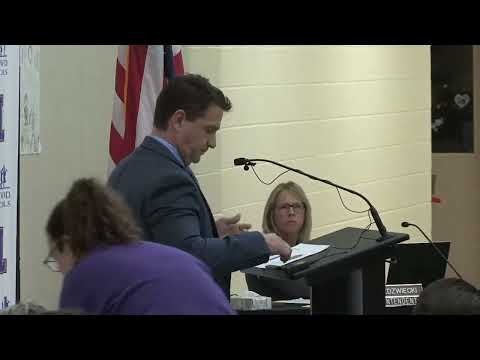
Kent Zeman, treasurer for Lakewood City Schools, told the board that House and gubernatorial budget proposals being considered in Columbus would sharply reduce locally approved levy revenue and accelerate a decline in the district's cash balance unless the state changes course.
Kent Zeman, treasurer for Lakewood City Schools, told the Lakewood City Schools Board of Education that state budget proposals under consideration could substantially reduce revenue the district now receives from local levies.
"This is the first year since the community supported the 2020 levy that expenditures are exceeding revenues," Zeman said, and he reported that the district's general fund revenues for the current year total just over $85,000,000 while expenditures are coming in at $88,200,000. He said the district's 2020 operating levy originally brought in about $3,900,000 and remains constrained by House Bill 920, which limits levy revenue to the amount it produced when first approved.
Zeman said Lakewood is a property-tax-driven, "guaranteed" district under the state's fair school funding plan and that roughly 60% of the district's revenue comes from local property taxes while about 27% is state funding (including what he described as a 6% portion that represents property tax reimbursements from the state). He said the district receives roughly $18,000,000 under the state's funding guarantee that has been stable since 2008.
On the possible effects of legislation in Columbus, Zeman said the House proposal would allow the local county budget commission — the county auditor, county prosecutor and county treasurer — to reduce levy distributions when a district's cash balance exceeds 108 days (about 30 percent). "That would be represented as a tax credit that would reduce for Lakewood City Schools," he said, and he estimated the impact to the district at "approximately $14,000,000 over a 2 year period," which he described as about $7,000,000 in each of the two years.
Zeman showed board members a forecast in which the district's cash balance declines over time as expenditures outpace revenue, and he said the House proposal would deplete the district's cash balance much more rapidly. He noted the district's cash-balance policy: a minimum of 90 days on hand, and an internal requirement that if the balance exceeds 150 days, the superintendent and treasurer must report to the board how the excess will be used.
Board members asked procedural and timing questions. Zeman confirmed he had submitted written testimony to the state Senate opposing the House proposal and described the next steps: the Senate will produce its own proposal, conferees will reconcile the House and Senate versions in conference committee, and the final bill would go to the governor. He told the board he expects the budget to be resolved by June 30 under the statutory deadline.
Zeman also described differences among the proposals. He said the governor's proposal includes reductions to the guarantee that would amount to a multi‑year revenue loss the district estimated at roughly $4.5 million in total, while the House proposal's cash‑balance clampback would remove levy dollars as the county budget commission implements tax credits. He cautioned that once those levy dollars are withheld under the House approach, they are not automatically returned if the district later falls below the 108‑day threshold.
He placed the local impact in context: the district's 2024 expenditure per pupil was $20,698 — the 15th lowest in Cuyahoga County, he said — and local property taxes currently account for about 48–43% (he cited the roughly 60% local share earlier when describing revenue sources) of general fund revenue depending on how categories are counted. Zeman said the district has historically relied on community‑supported levies (passed in 2013 and 2020) and that, if the House proposal becomes law, the district might need to seek operating levies more frequently (for example, on a two‑year cycle) to stay under the proposed cash‑balance cap while maintaining operations.
Zeman and board members discussed advocacy options. He said statewide organizations representing school boards and administrators were mobilizing against the proposal and that he had asked the board to consider drafting or passing a resolution and to submit written testimony. "I can share the testimony with whomever would like it and they could use that to submit their own written testimony," he said.
No board motion or vote was taken during the presentation. Zeman characterized the situation as uncertain: "We'll know, hopefully, by June 30 what the result of it is," he said, and he urged continued local advocacy and coordination with state legislators.
The presentation included several clarifying figures and policy notes that Zeman attributed to the current forecast and to the proposed state budget options; board members pressed for additional detail on timing, recalculation triggers, and how withheld dollars would appear on property tax bills as credits rather than proportional cuts to all local governments.
Questions and discussion continued; Zeman answered that, under the scenarios discussed, a levy passed in 2026 would not produce a full year's collections until 2028 because of the timing differences among tax, calendar and fiscal years. He also said county auditors' associations had expressed opposition to the House approach and that many statewide education organizations were lobbying the Legislature. The presentation concluded without board action and with an agreement to return to advocacy discussion at a future meeting if needed.