Get Full Government Meeting Transcripts, Videos, & Alerts Forever!
Get email alerts on the School Board Election topic
No spam. Unsubscribe anytime.
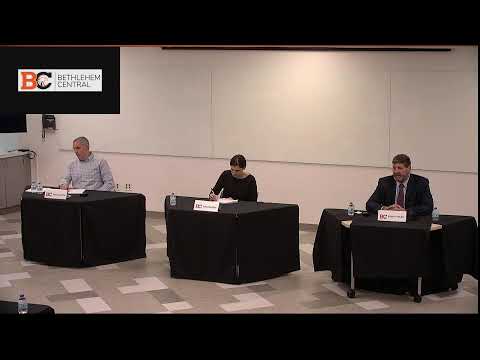
Three candidates vie for two seats on Bethlehem Central School District board; forum centers on safety, special education and redistricting
Summary
At a League of Women Voters forum at Bethlehem High School, candidates Susie Barber, John Walston and Bob Tietjen discussed school safety, special education supports, high‑school start times, a proposed change to the state "hold harmless" aid practice and planned elementary redistricting.
Three candidates for two open seats on the Bethlehem Central School District Board of Education — Susie Barber, John Walston and Bob Tietjen — answered questions at a League of Women Voters forum at Bethlehem High School. The candidates discussed school safety, services for students with disabilities, start times, the state budget "hold harmless" proposal and planned elementary‑school boundary changes, among other topics.
The forum, moderated by Margie Skinner of the League of Women Voters of Albany County, drew sustained attention to school safety and district responses after recent incidents. John Walston, a three‑year incumbent on the board, said the district has been "doing a very effective job" on safety and praised the relationship with local police: "We're very blessed to have a really great relationship with the SROs and the police department," he said. Candidates noted physical security work already underway, including hardened entrances and a door‑monitoring system, and emphasized budgeting and contract limits when discussing adding School Resource Officers (SROs). Several candidates said the district currently contracts for two SROs.
Special education supports and family communication were recurring themes. Susie Barber, a teacher who said she works in Niskayuna, emphasized individualized planning: "Meeting each student where they're at... that's why they have their IEPs," she said, and called for close communication among teachers, parents and the board. John Walston said parent organization and feedback have increased: "A lot of the parents who are involved... seem to be sharing more, organizing better," he said, and argued that better parent advocacy helps the board respond through policy and budget decisions. Bob Tietjen said the board's role is to ensure the special education department has resources and to act as a conduit between parents and administration.
On the question of high‑school start times, candidates acknowledged scientific evidence favoring later starts but stressed logistical obstacles. "Once you get into how the sausage is made, it's a lot more complex," said Bob Tietjen, citing bus routes, union rules and scheduling. John Walston noted the district's prior analysis and said a modest shift — "the best case scenario ended up being like 26 minutes" — was the largest near‑term change the district could realistically implement.
Candidates said they were not yet prepared to detail how a proposed change in the state's "hold harmless" aid practice would affect Bethlehem's finances. Susie Barber and John Walston said they were not sufficiently informed to speak about specifics; Bob Tietjen said the issue "hasn't percolated up to such a degree that we were concerned about it at all." Viewers were directed to the district's budget presentation online for official numbers.
Other topics included mental‑health support, coach conduct and curriculum. Candidates uniformly said mental‑health response is led by trained school professionals and that the board's role is to fund and support those services. On coach conduct they said policies and established reporting processes exist and that the athletic director meets with coaches each season to review expectations. Literacy and early reading drew near‑unanimous support as district priorities; candidates said the district tracks progress with diagnostic tools and has adopted new reading programs in recent years.
Planned elementary‑school boundary changes in 2026–27 drew sharp interest from the audience. All three candidates said the district should proceed carefully and use professional consultants. "We can't have 30 kids in the classroom over here and 10 students in the classroom over here," Tietjen said, arguing the goal is equitable class sizes and staffing.
The candidates gave closing remarks and urged voters to participate in next week's election at the high school; the moderator reminded listeners of voter eligibility rules and hours. No formal votes or actions occurred at the forum; it served as a public information event in the run‑up to the district election.
The forum provided a window into how each candidate would approach fiscal constraints and competing priorities: Barber emphasized classroom experience and communication, Walston emphasized continuity and constituent feedback, and Tietjen emphasized process, policy and district stewardship.