Get Full Government Meeting Transcripts, Videos, & Alerts Forever!
Get email alerts on the Adu Ordinance topic
No spam. Unsubscribe anytime.
Committee recommends ADU rule changes, accepts state limits on owner-occupancy
Summary
After discussion and amendments, the committee recommended the ADU ordinance to the full council with changes clarifying utility requirements for detached ADUs, allowing one ADU per principal unit by special permit on multi-unit lots, and aligning local rules with state law that prohibits owner-occupancy requirements.
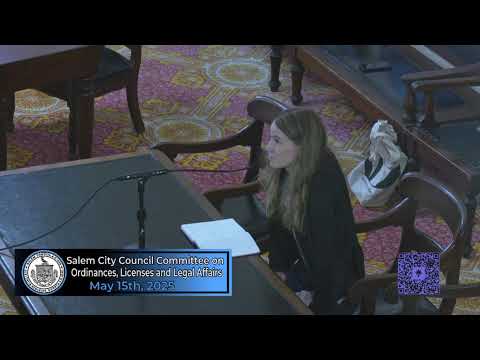
The Salem City Council Committee on Ordinances and Legal Affairs on May 15 voted to forward an amended accessory dwelling unit (ADU) ordinance to the full council, adopting staff redlines and council amendments that reconcile local standards with the state’s Affordable Homes Act.
Amanda Chincola of the Salem Planning Department briefed the committee on three categories of edits: changes required by state law, clarifications the city added, and locally proposed conditions. She said the state “specifically says that communities are required to allow accessory dwelling units as of right” and that the state bars local owner-occupancy requirements for ADUs.
Where the city added local conditions, the committee accepted several staff proposals: (1) correct a zoning-table error to allow ADUs in a zoning district that already permits single-family homes; (2) require detached ADUs that are not owner-occupied to have separate water, sewer and electric services where electrical code or city engineering require it; and (3) provide a special-permit track so lots with multiple principal dwelling units (two to five units) may have one ADU per principal unit by special permit.
Chincola said staff removed an owner-occupancy condition because the state statute prohibits it and noted that the electric code already requires separate service panels in some cases. She explained the proposed ordinance includes a transparency provision so applicants know whether separate services will be required before applying for building permits.
Council debate focused on equity, neighborhood character and unintended consequences. Councilor Harvey argued that allowing non–owner-occupied ADUs and multiple ADUs on certain lots could enable investors to convert single-family neighborhoods into rental properties; he said that could reduce property values for long-term homeowners. Councilor Cohen and others said the amended language limits multiple ADUs to lots that already contain multiple principal dwelling units (e.g., nonconforming multi-family structures) and does not permit a single-family parcel to add multiple principal dwelling units through the ADU rules.
The committee approved an amendment, moved by Councilor Cohen, that states: “There shall be one accessory dwelling unit by right on a lot. A lot with two to five dwelling units may have one accessory dwelling unit per principal dwelling unit by special permit per section 9.4.” The amendment passed on a committee vote and the committee moved the ordinance to the full council with a positive recommendation for second passage.
Staff provided data on the city’s modest ADU tax-exemption usage: eight properties received the exemption in 2025 (totaling about $3,800), and staff reported 14 certificates of occupancy for ADUs between 2022 and 2025. Planning staff said parking requirements for ADUs remain unchanged — the draft carries forward the existing approach of not requiring additional off-street parking for ADUs.
Public commenters were split. Several residents, including Carol Carr and Justin Whittier, urged the committee to retain owner-occupancy or stronger affordability safeguards to prevent investor-driven conversions; others, such as Lydia King, urged wider production of smaller units and supported the committee’s alignment with state law.
With the committee’s recommendation, the ordinance (as amended) will go to the full Salem City Council for a second-passage vote. Staff said they will provide the final ordinance language and that the state-level guidance (EOHLC) informs implementation distinctions about what counts as a single-family zoning district and what local measures are permissible.