Get Full Government Meeting Transcripts, Videos, & Alerts Forever!
Get email alerts on the Education Levy topic
No spam. Unsubscribe anytime.
Seattle committee hears overview of proposed $1.3 billion Families, Education, Preschool and Promise levy
Summary
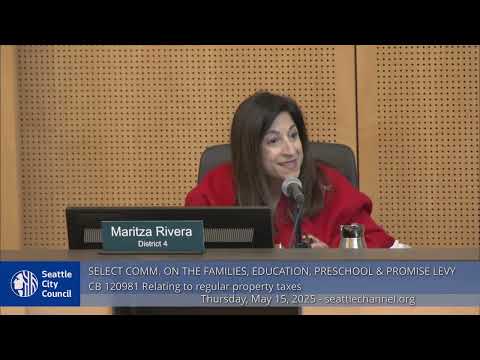
Chair Maritz Rivera opened the Select Committee on Families, Education, Preschool and Promise Levy on May 15 to consider Council Bill 120981, a proposed six-year property-tax levy renewal that would generate an estimated $1.254 billion in tax proceeds (about $1.326 billion total spend plan) to expand early learning, K–12 supports and Seattle Promise if approved by voters.
Chair Maritz Rivera opened the Select Committee on Families, Education, Preschool and Promise Levy on May 15, 2025, to hear central staff analysis of Council Bill 120981, a proposed levy renewal the ordinance would send a property-tax lid lift to the November ballot and, if approved by voters, fund a six-year package for early learning, K–12 supports and Seattle Promise.
The levy proposal would replace the expiring 2018 Families, Education, Preschool and Promise (FEP) levy and is written to authorize approximately $1.254 billion in property-tax proceeds over six years and a $1.326 billion total spend plan that includes carryforward and interest, according to Jasmine Marwaha, council central staff. "There is a reason we got to a $1,300,000,000 figure," Marwaha said as she outlined the revenue and spend estimates and how the package breaks down between continuing prior investments, switching some youth programs to levy funding, and program expansion.
Why it matters: the ordinance frames broad priorities and authorizes the city to levy additional regular property taxes and create a designated fund for investments intended to increase access to early learning and preschool slots, support childcare workers, fund school-based health and mental-health services, support youth-violence prevention for K–12 students, and continue Seattle Promise pathways for high school graduates. Chair Maritz Rivera said the proposal was a joint effort between the mayor’s office and the committee and described the next step as development of an implementation and evaluation plan. "It is my intent to have this legislation go on the ballot as carefully written," Rivera said.
Key details presented - The 2018 FEP levy provided $620,000,000 over seven years and expires at the end of 2025; the current proposal substantially increases funding compared with that levy (Marwaha described the increase as a 236% rise from the last levy). - Marwaha provided two headline totals: $1,254,000,000 in estimated property-tax proceeds over six years, and $1,326,000,000 as the estimated spend plan when prior-levy carryforward and interest earnings are included. The presentation explained that most of the package would continue investments from the 2018 levy, about 22% could transition existing youth programs funded outside the levy to levy funding, and roughly 20% would support program expansion. - The ordinance is written as an establishing measure with high-level priorities and a non-exhaustive list of allowable educational support services; a detailed seven-year spend plan would be adopted later, if the levy passes, via an implementation and evaluation plan considered in the first quarter of 2026 and then by ordinance during regular budget processes. - Contracting language in the ordinance authorizes the Department of Education and Early Learning (DEEL) to use competitive processes for agreements but includes exceptions for emergencies or sole-source situations; Marwaha noted those exceptions mirror existing municipal code practices and said council may request additional transparency when the department forgoes competition.
Discussion and next steps Committee members expressed the balance they want between ballot clarity and administrative flexibility. Several members, including Councilmember Rink and Councilmember Saka, asked whether the levy language should be more specific about how broad buckets (for example, "school safety" or childcare) would be used or whether specificity is better left to the implementation and evaluation plan. Marwaha and Chair Rivera explained that levies commonly use broader establishing language so that implementation details can be set later; Rivera noted that more detailed program direction can be supplied in the implementation plan because voters cannot be bound by changes beyond what is placed on the ballot.
The committee did not take a vote on Council Bill 120981 during the meeting. The chair and staff laid out a schedule for amendments and review: council members were asked to provide amendment requests to Marwaha by the Thursday following the meeting so staff could prepare proposed amendments for the May 29 committee meeting, with a goal of a full council vote on June 24. Marwaha also said that two other committee meetings remain available for amendment discussion.
Procedural items The committee adopted the meeting agenda by unanimous consent at the start of the session and the clerk read Council Bill 120981 into the record. No public commenters were signed up for the hybrid public comment period.
Ending The committee adjourned after confirming its next meeting for May 29, 2025, at 9:30 a.m.; staff and members were asked to coordinate on any proposed language changes before the next meeting so amendments could be prepared.