Get Full Government Meeting Transcripts, Videos, & Alerts Forever!
Get email alerts on the Utilities System Development Charges topic
No spam. Unsubscribe anytime.
Seattle Public Utilities proposes citywide system-development charge to share costs of new mains
Summary
Seattle Public Utilities outlined an ordinance package to create and raise system development charges (SDCs) for water, wastewater and drainage so new development pays into a cost‑sharing fund for expensive mainline extensions; no vote was taken at the May 14 committee briefing.
Seattle Public Utilities presented a package of three ordinances to the Parks, Utilities, Technology Committee on May 14 to create and raise system development charges for water, sewer and stormwater so developers and property owners who connect to the utility system pay a shared fee that can help fund mainline extensions. The legislation was presented for briefing and discussion; committee members did not vote on the ordinances at the meeting.
SPU General Manager and CEO Andrew Lee said the goal of the proposal is to reduce what the department described as an inequity: interior parcels without mains often face mainline-extension costs that can run “hundreds of thousands of dollars,” while neighboring properties with mains in the street pay far less. Lee and SPU staff said the proposal would increase SDCs for all new connections so the pooled revenue could be used to cost‑share expensive extensions and make redevelopment more predictable and feasible.
The proposal would: revise water SDCs, establish new SDCs for drainage and wastewater, authorize a municipal assessment reimbursement area authority (a latecomer/assessment mechanism), and add staff and appropriation authority to SPU’s 2025 budget to administer the program. Council Central Staff said the package is reflected across three council bills (council bill 120966 through 120968) and that a technical drafting correction is proposed to fix a cross‑reference in Seattle Municipal Code.
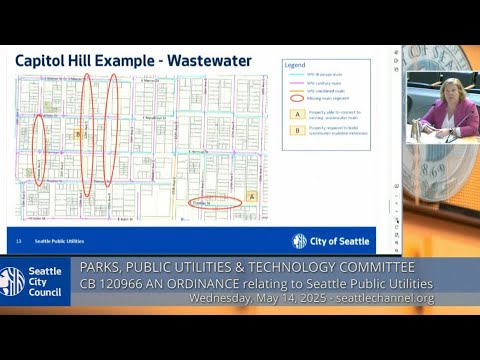
SPU staff walked through maps and parcel‑level examples to show the scale of the issue. Alex Chen, SPU deputy director for drinking water, said Seattle has about 1,600 miles of water mains and estimated roughly 25% of streets lack a full north‑south/east‑west “gridded” main, or roughly 400 miles of streets without mains. SPU showed examples in Beacon Hill, Ballard and Capitol Hill illustrating long private service lines and blocks where a mainline extension would be required for redevelopment.
SPU provided three illustrative homeowner/developer scenarios: modest remodels and backyard cottages that add little impervious surface would see minor changes; by contrast, subdividing lots under state housing legislation (identified in the briefing as “housing bill 11 10”) can trigger mainline extensions with large costs under the current rules. In one Beacon Hill example SPU showed a status‑quo mainline extension cost of nearly $400,000 versus an estimated $45,000 obligation under the proposed SDC cost‑share. In a Capitol Hill example SPU said a current mainline extension cost of about $155,520 could be reduced to $48,320 under the proposal, with SPU providing roughly $120,000 of funding toward the extension in that scenario.
SPU and Council Central staff acknowledged tradeoffs. Carrie Burchard Juarez, deputy director for project delivery and engineering, said stakeholders who serve townhomes may prefer individual meters and will therefore pay per‑unit SDCs; SPU’s example showing master‑metered townhomes does not reflect every market choice. Council members raised affordability concerns for retirees and other residents who might be affected by higher SDCs when they seek small additions or accessory units.
Council Central staff summarized the three bills: the SDC revisions and new drainage/wastewater SDCs; authority to create municipal assessment reimbursement areas to let SPU advance projects and collect latecomer payments; and a budget amendment to add six positions and $950,000 in appropriation authority (funded from the anticipated SDC revenues) to administer the program. Staff noted one technical amendment to fix a drafting error in the introduced bill.
Public testimony at the committee included developers and consultants who urged careful calibration (for example, Blueprint Capital Services representative Luca de Herrera raised estimates that fees could be $30,000–$40,000 for certain four‑unit projects under some meter assumptions) and civil engineer Donna Bresky who described small developers’ sensitivity to capital improvement requirements. Several council members said they were continuing to review the details and appreciated SPU’s outreach and parcel maps; no formal action or vote occurred. Committee members and SPU staff indicated further meetings and a future committee vote would be scheduled.
The committee did not adopt or vote on the ordinances during the May 14 briefing; staff and council members said they will continue outreach and return with more analysis and potential amendments at subsequent meetings. SPU told the committee the intent of the package is to make costs for redevelopment more predictable and to increase system resiliency by funding missing mains.