Get Full Government Meeting Transcripts, Videos, & Alerts Forever!
Get email alerts on the Animal Welfare topic
No spam. Unsubscribe anytime.
West Valley Humane Society asks Nampa for sharply higher contribution as shelter stabilizes; council defers decision
Summary
West Valley Humane Society presented a request for increased municipal support and outlined shelter finances, recent stabilization work and operational limits; Nampa council members asked for more data and agreed to coordinate with county and Caldwell before budget decisions.
West Valley Humane Society told the Nampa City Council on Wednesday it is seeking significantly larger municipal support for fiscal year 2026 after a year of stabilizing operations and tightening costs.
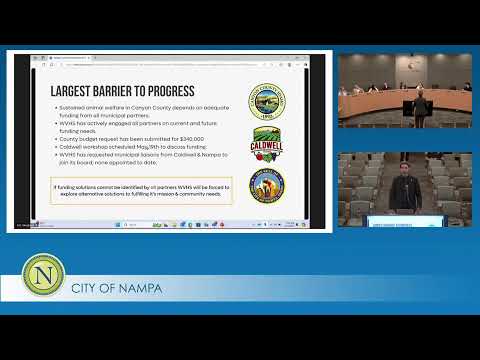
Nick Lippincott, board president of West Valley Humane Society, said the organization is proposing a rebalanced contribution model that would ask Nampa for $720,000, Caldwell for $540,000 and Canyon County for $240,000 for FY26. He said the shelter’s total operating budget is just over $2.5 million and the nonprofit is still using one‑time stabilization funding; without additional partner support the organization will exhaust its reserves in early 2026.
Why it matters: The shelter provides intake and care for strays and seized animals for municipalities and the unincorporated county. Council members were told that if Nampa sharply reduces or withdraws its contract, West Valley may stop handling Nampa strays, which would shift costs and animal intake patterns to neighboring jurisdictions and could leave Nampa residents with fewer local options.
Nampa Police Department animal control supervisor Eric Skoglund provided operational statistics. He said costs to the city for emergency veterinary care at contracted providers (Viking Veterinary) were about $6,000 in FY23, $4,000 in FY24 and are about $7,000 year‑to‑date. He reported intake trends of roughly 469 animals in 2022 and 539 in 2023 and said officers have worked to increase reunification to reduce shelter intake.
Lippincott described actions taken since mid‑2024 to stabilize West Valley after an overcrowding and staffing crisis. He said national partners — including Best Friends Animal Society and Idaho Humane Society — assisted with operational support and recommendations. He said Best Friends provided a one‑time stabilizing grant of $450,000 that kept the shelter operating during the fiscal year.
The shelter’s financial picture and timing: Lippincott said West Valley has reduced operating costs by roughly 36% year‑to‑date but still has a monthly net cash burn of about $42,000. He said that at current run rates the organization will exhaust that funding by February 2026 if additional revenue or partner contributions are not secured. He urged the council that contracts set many of the shelter’s obligations — for example a required five business‑day stray hold period and longer protective‑custody holds for seized animals — which increase average care costs; West Valley’s current average length of stay is about eight days for dogs and roughly ten days for cats.
Contract history and comparative funding: Eric Skoglund reminded the council that Nampa’s contract with West Valley was about $83,300 in the prior year; he said Caldwell’s contract was roughly $68,200 and county contract funding historically has been larger (around $300,000 in earlier years). Lippincott provided a per‑capita comparison showing Nampa’s sheltering contribution is under $1 per resident (less than $0.75 per capita in the presentation), Caldwell at about $0.90 and the county at about $4.23 per capita for sheltering services.
Council response and next steps: Council members expressed concern about the size of the requested increase and said the decision will require coordination with Canyon County and Caldwell. Councilmember Jengula and others urged a joint meeting with the county and neighboring cities to discuss a unified approach; several council members said funding should not be expected entirely from the Nampa general fund. The council asked staff to obtain more precise residency data for intakes (number of Nampa addresses in intake records) and asked for copies of the county contract model used by Ada County as an example of a joint funding approach.
Lippincott suggested appointing a nonvoting city liaison to West Valley’s board to improve information flow; council members said they would identify a staff member to serve as liaison and requested additional financial detail from the shelter for budget deliberations.
No vote was taken. Council members said they would consider West Valley’s request during the FY26 budget process and plan to coordinate with Canyon County and Caldwell before making a final decision.
Ending: West Valley Humane Society asked municipal partners for larger, ongoing support to continue contracted sheltering services and to expand nonprofit programs that reduce intake pressure (community cat/TNR, reunification, adoption services). Council members acknowledged the urgency and asked for supplemental data and a joint jurisdiction meeting before budget adoption.