Get email alerts on the Streets Cip topic
No spam. Unsubscribe anytime.
Plan Commission recommends 2026–2031 six‑year streets program, emphasizing pedestrian and school safety projects
Summary
The Spokane Plan Commission voted 6‑0 to recommend the 2026–2031 six‑year Streets Capital Improvement Program to City Council, adding 15 new projects — many grant‑funded — that prioritize pedestrian and school‑area safety, bike network elements and several large corridor studies.
The Spokane Plan Commission on Wednesday recommended that City Council consider adopting the city’s 2026–2031 six‑year Streets Capital Improvement Program, a package that adds 15 new projects and emphasizes pedestrian and school‑area safety. The commission’s recommendation was unanimous, 6‑0.
The commission heard a roughly hour‑long presentation from Kevin Picasso, principal engineer with Integrated Capital Management, who said the program update focuses on new projects entering the six‑year program and their consistency with the transportation chapter of the comprehensive plan. "Our primary reason for being here today is for that hearing," Picasso said, summarizing the projects and the schedule that leads to a council hearing and possible adoption before June.
The hearing matters because the city's street capital program is the mechanism to program street improvement projects that advance the comprehensive plan’s transportation goals, and state law (RCW) requires the city to maintain an updated streets capital program prior to July 1 each year. Picasso told the commission the package includes 15 new projects, seven of which are grant funded, "totaling roughly $12,000,000." Several of the grant‑funded projects are targeted at pedestrian and school safety and come from programs such as the Highway Safety Improvement Program and Transportation Improvement Board grants.
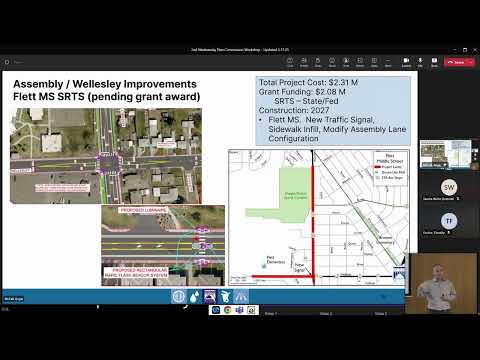
Commissioners and staff discussed major elements of the proposal. Key additions include: a high‑visibility crosswalk program (35–40 locations, HSIP funded); the Driscoll sidewalk fill‑in from Garland to Wellesley (TIB grant, roughly $1.7 million total with TIB covering about half); multiple Safe Routes to School investments near Flood Middle School and Sacajawea‑Mill Middle School; two new traffic signals at Rowland/Maple and Ash; an approximately 27‑mile bike network concept (“27 by 2027”) to be implemented in phases; Division‑area BRT active‑transportation projects; and several larger, outer‑year capacity projects such as Sprague Avenue downtown rebuild and intersection projects at 30th & Ray and Hatch/50th.
Picasso described funding sources and program mechanics: impact fees fund portions of some projects (generally about 50% of listed costs), grant awards fund others, and many projects are contingent on successful grant applications and coordination with other agencies (for example, Spokane Transit Authority for Sprague). He said some projects are planning studies or preliminary phases that would later advance into design and construction as funding is secured.
Commissioners asked about specific design elements: whether the 20th Avenue (20th Avenue/20th Avenue corridor referenced as "20 Ninth Avenue" in the presentation) road diets would provide marked bike lanes or primarily pedestrian safety improvements. Picasso said several corridors would be restriped from four lanes to three for safety and pedestrian improvements and might include shoulder space that could be used by confident cyclists, but that not all corridors would receive designated, separated bike lanes; some higher‑volume routes (for example, Grand Boulevard) are identified for protected bike lane treatments if funding and right‑of‑way permit.
Commissioners also discussed the traffic impact fee program, which maintains a 20‑year vision of capacity projects; incremental additions to the six‑year program come from that longer list. Picasso said the impact fee program does not fully fund projects and typically covers about half of a project’s cost, requiring the city to secure grants or other funding to complete construction.
Following questions and limited public testimony (none online), Commissioner motioned to recommend approval to City Council; the roll call vote recorded Vice President Patterson, Commissioner Francis, Commissioner Leonhart, Commissioner Schuck, Commissioner Williams and one other commissioner as voting aye, producing a 6‑0 recommendation.
The recommendation does not itself appropriate construction funds. Several projects are listed as planning or design phases or are contingent on grant awards; staff said individual projects will return to the appropriate review bodies, and project details will be refined in future design phases. The commission noted the update contains the largest number of new projects added to the program in a decade and urged continued focus on school‑area safety and community engagement as projects move forward.
AI generated
The text on this page is AI generated. Summaries, highlights, analysis, and video transcripts are all produced from the original source material.
AI can make mistakes, so if you spot one, and we will fix it for everyone.
Note: the source content is unaltered by us. Any content source we link to, be it a video, an audio recording, or a document, is presented exactly as its publisher released it. That publisher is usually a government body, sometimes an individual official or another organisation.