Get Full Government Meeting Transcripts, Videos, & Alerts Forever!
Get email alerts on the Parking topic
No spam. Unsubscribe anytime.
Buena Vista staff urges studies before cutting off-street parking requirements; trustees ask for local data
Summary
Planning director Margaret Kopp told trustees that minimum parking rules add to development cost and that town’s $1,200 fee‑in‑lieu does not cover the real cost of shared parking. Trustees asked staff for more local data, directed further review with Planning & Zoning and signaled interest in targeted studies focused on Main Street.
Margaret Kopp, the town of Buena Vista planning director, briefed the Board of Trustees on May 13 on an "off‑street parking review" that compared the town’s requirements and alternatives to other Colorado communities and outlined tradeoffs for density and housing cost.
Kopp said minimum off‑street parking requirements “directly add to the cost of development” and summarized four questions for trustees: are existing requirements sufficient; should changes be townwide or only in specific zones; are alternatives adequate; and does the fee‑in‑lieu cover the true cost.
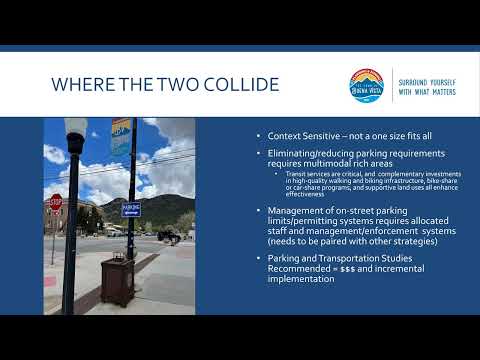
The presentation emphasized the planning rationale behind parking rules—reducing congestion, encouraging multimodal travel and limiting impervious surface—and flagged local limits: Buena Vista does not yet have a fully developed multimodal network and on‑street parking is public right‑of‑way that would require permit, enforcement and staff to dedicate spaces. Kopp noted the town’s fee‑in‑lieu for parking is currently $1,200 per space and said, “my understanding was that the intent was that the $1,200 is the material cost,” adding that amount “does not cover the cost” of shared parking or structured spaces.
Trustees and residents pressed staff for more localized figures. One trustee walked the board through a near‑Main Street parcel listing and estimated that acquiring two existing lots and converting them into roughly 40 spaces would imply a roughly $16,000 cost per space—far above the town’s fee. Kopp also cited wider industry ranges: surface spaces often run $5,000–$10,000 per stall while structured parking can reach $25,000–$50,000 per stall depending on materials and land cost.
Kopp reviewed existing code mechanics: Old Town 25‑foot lots use a 1.5‑spaces‑per‑25‑foot rule; the Unified Development Code (UDC) adopted in 2018 contains the standard table of parking requirements and also lists alternatives and credits. She said she had compared Buena Vista’s requirements with Front Range municipalities and Salida and found Buena Vista’s base requirements generally lower; but alternatives—and availability of multimodal options—shape feasibility.
Board members debated tradeoffs. Some trustees and public commenters advocated keeping vehicle options in a car‑dependent mountain valley; others argued the town should encourage multimodal travel and lower parking minimums to support density and affordability. Bicycle parking and credits for multimodal investments drew specific discussion: Kopp noted how recent proposals counted bicycle spaces toward vehicle spaces and that the Cedar Street condominiums had been required to provide 28 bike spaces (two bikes per required bike space) and proposed 36 as an alternative count.
Trustees asked staff for targeted next steps rather than an immediate code change. Kopp recommended focusing study efforts on corridors with the most frequent reduction requests—Main Street was repeatedly cited—and completing a parking and transportation study before any wholesale reduction of requirements. Trustees directed staff to return with local data on existing development: current parking ratios at higher‑density complexes, the town’s public parking inventory, and a defensible per‑space cost that could inform a revised fee‑in‑lieu. Kopp said staff would solicit Planning & Zoning input and noted a fee‑schedule amendment is already on an upcoming town meeting cycle for consideration.
The board did not take a binding vote to change parking minimums; instead trustees asked staff to compile local comparables, estimate public parking capacity, and prepare for a follow‑up work session and Planning & Zoning review.
Ending: Trustees left the session without changing code language; staff will return with a local data package, recommended threshold(s) for any fee‑in‑lieu change, and suggested scope for a focused parking/transportation study aimed at Main Street and other high‑demand corridors.