Get Full Government Meeting Transcripts, Videos, & Alerts Forever!
Get email alerts on the Land Use Procedures topic
No spam. Unsubscribe anytime.
Evanston land use commissioners receive training on standards, ex parte rules and Open Meetings Act
Summary
At a May 14 Land Use Commission session, American Planning Association trainers reviewed commissioners' roles, standards of review including LaSalle factors, staff duties, ex parte communications and Open Meetings Act constraints.
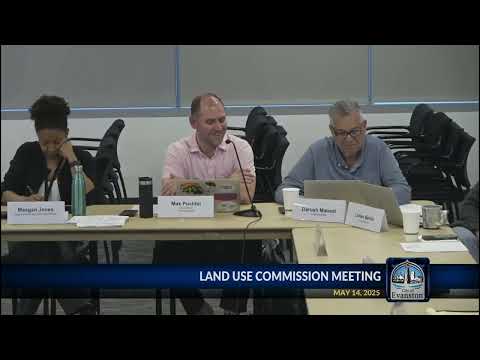
Evanston's Land Use Commission spent most of its May 14 meeting in a training session led by two planners from the Illinois chapter of the American Planning Association, who reviewed how commissioners should apply zoning standards, handle contacts outside hearings and work with staff.
The session — led by Michael Blue of Tesco Associates and David Silverman of Anselm Link — covered the commission's role in applying the city's zoning ordinance, the legal and factual basis for findings of fact, and procedures that reduce legal risk, including limiting ex parte communication, documenting deliberations and following the Open Meetings Act.
The training matters because plan commissioners make recommendations (and in some cases final decisions) that carry legal and policy consequences. Blue and Silverman emphasized that following the zoning ordinance's standards and creating a clear record helps protect recommendations from being overturned in court.
Blue told commissioners the staff’s duty is to manage the process, not to advocate for a project. "The staff work for the city. They are here to manage the process. They are not advocates for the process," he said. Silverman added that elected officials have a broader, legislative role and that commissioners’ authority is more narrowly constrained by the zoning code and the findings of fact they must make.
Trainers reviewed several practical points commissioners and the public should expect when projects come before the commission: read the staff report, visit sites from public ways (but do not enter private property), call staff with procedural questions before hearings, and use conditions of approval to mitigate project impacts. The trainers discussed how objective evidence such as traffic and stormwater engineering is weighed alongside neighborhood testimony and noted that not every zoning standard will be equally relevant for every application.
On legal standards, presenters explained Illinois’ commonly cited LaSalle factors and how findings of fact anchor administrative decisions. Silverman said those standards are the framework courts use when reviewing land-use decisions for arbitrariness. Trainers warned commissioners that a seemingly minor factual gap in the record can carry legal consequences if a decision is later challenged.
The session also covered ethics, conflicts of interest and the Open Meetings Act. Trainers warned against informal communications that could create a perception of impropriety: do not engage in private, substantive conversations about pending cases with other commissioners or a majority of the commission outside the public hearing. Trainers recommended routing substantive contacts through staff and recording any necessary disclosures on the public record. They also advised caution with electronic communications — "email is not your friend" for commission business — and stressed the city’s gift/ethics rules.
Commissioners asked about how to weigh competing public comments and how to apply standards in close cases. Presenters recommended focusing on written staff analysis and objective evidence where available and, when needed, asking for additional study (for example, a traffic or parking analysis) rather than deferring decisions where the record is incomplete.
The meeting opened with a quorum of six members present and approved minutes from the Jan. 15 meeting by unanimous consent before the training began. The trainers concluded after roughly two hours of discussion and fielded questions about how standards and city policy (including the comprehensive plan) should guide commissioners’ deliberations.
The training closed with a reminder from trainers that when in doubt commissioners should consult staff or the city attorney before taking cases or discussing pending matters outside of public hearings, and that clear findings tied to the ordinance help create defensible, transparent decisions going forward.