Get Full Government Meeting Transcripts, Videos, & Alerts Forever!
Get email alerts on the Alternative Birthing Clinic Regulations topic
No spam. Unsubscribe anytime.
OSHPD asks public to help "right-size" Title 24 rules for alternative birthing clinics
Summary
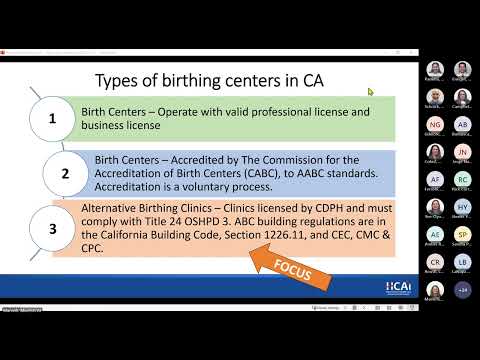
The Office of Statewide Health Planning and Development hosted a virtual public meeting to review Title 24 building standards for alternative birthing clinics and solicit stakeholder input on possible code changes and a guidance document.
The Office of Statewide Health Planning and Development hosted a virtual public meeting to review Title 24 building standards for alternative birthing clinics and solicit stakeholder input on possible code changes and a guidance document.
OSHPD Supervisor Mia Marbelli, who leads the Building Standards Unit, opened the session and said the agency plans to "spend the bulk of the two hours today discussing the Title 24 regulations themselves" and welcomed public comment and technical input.
The meeting focused on several recurring issues raised by clinic operators, midwives and local plan reviewers: minimum birthing-room size and configuration; nurse-call and bedside communication requirements; restroom and fixture counts for small clinics; ventilation and mechanical requirements; and whether guidance or checklists could streamline local permit reviews.
Why it matters: California has seen reductions in hospital labor-and-delivery services and stakeholders told OSHPD that building-code requirements can be a barrier for smaller community-based birth centers seeking licensure or for local jurisdictions when permitting remodels. OSHPD said it seeks to "right size" clinic code requirements so that safety is preserved while remodeling and small-site licensure are more feasible.
What OSHPD and CDPH said OSHPD staff summarized how the rules interact with licensing and other state codes. Marbelli explained that OSHPD amends Title 24 building standards and coordinates with the California Department of Public Health (CDPH), which issues licensing under Title 22. "When we talk about the health and safety code, we are talking about the law. And when we talk about titles, such as Title 24 or Title 22, we are talking about the California Code of Regulations," Marbelli said.
Clara Wu, compliance officer and registered nurse with OSHPD's building standards unit, summarized stakeholder outreach and the agency's small survey: OSHPD sent six questions on Feb. 19, 2025, to 31 birth centers and "received only five responses," she said. Respondents reported that two to three birthing rooms are common at their centers; OSHPD said the sample size is too small to draw general conclusions but that the findings inform its work on guidance and proposed changes.
Key technical topics discussed - Birthing-room size and location: Current OSHPD clinic language specifies a 200-square-foot minimum and a 12-foot clear dimension; Title 22 and national guidance use less prescriptive language (CDPH: "an area that can accommodate equipment, supplies and staff"). OSHPD staff said they will consider code changes and guidance to align Title 24 with recognized facility guidelines. "We will consider a code change for the birthing room," Marbelli said.
- Nurse call and bedside communication: OSHPD staff noted existing Title 24 provisions that list delivery and birthing rooms as spaces requiring nurse-call connections. Given many ABCs are small (often a few rooms), OSHPD said it may allow alternative communication devices rather than a full hospital-style nurse call system.
- Lighting: Jamie Schneck, senior electrical engineer, described the electrical code's illumination standards and the current practice of a 100-foot-candle requirement in the California Building Code. "This is different than what we would see from the ABC recommendations, which would be 70 foot candles," Schneck said; OSHPD said it will consider whether to align illumination requirements with ABC practice or retain the existing code.
- Ventilation and mechanical: OSHPD's mechanical staff explained that amendments draw on ASHRAE 170 and other health-care ventilation guidance to set ventilation rates, pressurization and filtration; the agency said it will clarify which outpatient functions require which ventilation rates and will consider outpatient-specific table updates.
- Plumbing and restrooms: OSHPD staff described plumbing-code fixture-count issues for small clinics. The current code generally distinguishes staff facilities from public/patient facilities; participants asked whether small ABCs could use shared fixtures or dedicated in-room toilets for patients while providing a separate staff restroom. OSHPD said that question requires more review and guidance for small clinics.
- Emergency equipment and crash cart: OSHPD said it will clarify expectations for emergency equipment in ABCs so requirements are not interpreted as needing a full hospital crash cart but do ensure access to emergency supplies.
Stakeholder comments and examples Participants from midwifery and design communities and a UCSF researcher described operational realities for community-based midwifery and birth centers. Jessica (Researcher, University of California, San Francisco) told OSHPD that community midwives provide safe care in nonstandard settings and said the regulatory burden and administrative costs can make it difficult for small operators to maintain birth centers. She urged OSHPD to design straightforward, practical guidance: "These governmental systems and requirements are unimaginably burdensome for them."
Local-plan-review experience also informed the discussion: several participants described inconsistent interpretations by local jurisdictions on toilet fixture counts and how that inconsistency can block permit approvals. One commenter recommended OSHPD include clearer definitions (for example, a defined "birthing room") in code or guidance to reduce local variation.
Guidance document and timeline OSHPD said it will draft an ABC guidance document and a checklist intended to help design professionals, operators and local jurisdictions interpret and apply current Title 24 requirements while code changes are considered. Staff asked attendees to submit technical comments and any supporting documents or law citations to regsunit@hcaigov.ca.gov (subject line: "ABC public meeting") and requested comments by May 31.
OSHPD staff described the rulemaking timeline: internal prioritization and draft language work is expected between June and August; OSHPD aims to finish internal work by October and submit rulemaking packages to the California Building Standards Commission by December. Any approved changes would be published in a supplement to the 2025 code and could take effect in July 2027. OSHPD also plans additional public meetings oriented to primary-care clinic issues in June and August.
What OSHPD did not decide No formal votes or regulatory adoptions occurred at the meeting. OSHPD collected technical questions and comments and stated staff will draft guidance and proposed code language for future public review but made no final code changes during this session.
Where to get materials and next steps OSHPD will post meeting materials and the comparison table referenced in the meeting to its website and asked interested parties to monitor the OSHPD/Department of Health Care Access and Information regs unit email for future draft language and meeting notices. The agency requested stakeholder comments by May 31 and said it will follow up with draft regulatory language and additional public sessions later in the summer.
Ending: The agency emphasized it wants technical input and practical suggestions for guidance and code language and reiterated that any formal code changes will go through the statutory rulemaking process before taking effect.