Get Full Government Meeting Transcripts, Videos, & Alerts Forever!
Get email alerts on the Criminal Procedure Indictment Notice topic
No spam. Unsubscribe anytime.
High court hears dispute over whether promotion-of-prostitution indictment must specify which conduct
Summary
The Texas Court of Criminal Appeals heard arguments in C.R. Williams v. State over whether an indictment charging "aggravated promotion of prostitution" must identify which of six statutory verbs the state relied on — a question the defense says implicates jury unanimity, notice and discovery rules.
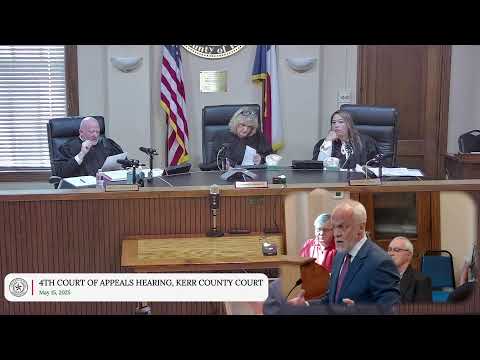
The Texas Court of Criminal Appeals, sitting in Kerrville, heard oral argument in C.R. Williams v. State of Texas on whether an indictment for aggravated promotion of prostitution must specify which of six statutory verbs the State relied on — an issue the defense says is necessary to ensure jury unanimity and adequate notice.
Mark Bennett, attorney for the appellant C.R. Williams, told the court that while the prior appellate reversal reached the correct result it did so “for the wrong reason,” and argued the trial court erred by denying a motion to quash the charging instrument. Bennett said the statute lists six verbs (for example: own, invest, finance, control, supervise, manage) and that allowing all six without clearer specification denied the defendant the notice required to prepare a defense. “Article 39.14 of the Code of Criminal Procedure ... was not complied with in this case,” Bennett said, arguing the record does not show discovery that would have cured the alleged notice defect.
Bennett asked the court to reverse and dismiss the indictment unless the record showed the defendant received adequate notice. He relied on Article 21.19 of the Texas Code of Criminal Procedure, which governs harmless-error review for errors in form, and argued that the cold record here does not establish lack of prejudice. Bennett also urged the court to consider the effect of recent U.S. Supreme Court and federal precedent on unanimity — citing Ramos v. Louisiana and Apprendi — to stress that what counts as an "element" can affect the Sixth Amendment unanimity requirement.
State counsel disputed parts of that analysis in their response filings and at oral argument, saying the charging instrument, together with the record, supplied sufficient notice and that longstanding Texas practice permits pleading alternative statutory methods of committing an offense without violating the right to jury unanimity. State counsel also emphasized waiver and forfeiture arguments, noting the appellant’s procedural posture on direct appeal and the absence of a complete record showing lack of notice.
During argument the parties debated two distinct legal questions: (1) whether the six statutory verbs are "elements" of the offense (which would require the State to obtain a unanimous jury finding on a specific verb), or instead are alternative "manner-and-means" allegations that do not require separate unanimity on each verb; and (2) if the verbs are treated as statutorily undefined terms, whether the defendant was entitled under precedent cited by counsel to a more specific description of how the State alleged the conduct (what counsel here referred to as the Maze/Mayes rule for notice of undefined statutory verbs). Bennett argued the defense lacked the record to show any cure by discovery and that Article 39.14(j)’s required discovery filing was absent from the record.
The justices pressed both sides on practical consequences. Counsel discussed whether failure to specify would require the State to elect a single theory at trial or whether a directed-verdict motion would supply a remedy if the State failed to prove particular alleged methods. Defense counsel said a pretrial motion to quash should have been granted based on inadequate notice as reflected in the charging instrument; state counsel countered that the defendant bore the burden to bring a complete record on direct appeal and that the charge and discovery practice in many counties supplies adequate notice.
After roughly three hours of argument, the court took the case under advisement. The justices did not announce a decision from the bench.
Why this matters: the court’s ruling could affect how prosecutors draft indictments for certain result-oriented offenses and whether defendants in Texas must be given more specific pretrial notice when statutes list multiple alternative conduct descriptions. It also raises questions about the interplay between Texas statutory procedure (Articles 21.19 and 39.14 of the Code of Criminal Procedure) and federal unanimity doctrine under Ramos and related precedent.
The court did not set a public date for a decision at the hearing; the case will be resolved through the court’s normal internal deliberative process.