Get Full Government Meeting Transcripts, Videos, & Alerts Forever!
Get email alerts on the Pedestrian Infrastructure topic
No spam. Unsubscribe anytime.
City presents French Prairie Road pathway update; Charbonneau residents engaged, pilot test planned
Summary
City staff and consultants updated the Wilsonville City Council on May 5 about plans to create a continuous, ADA‑compliant pathway around Charbonneau’s French Prairie Road and announced a pilot test to let residents experience lane‑repurposing options.
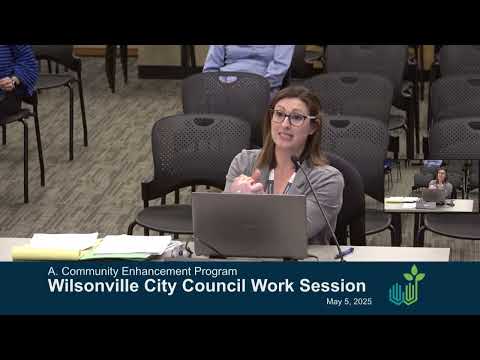
City staff and project consultants updated the Wilsonville City Council on the French Prairie Road Pathway Improvements Project on May 5, outlining a public engagement–driven process to create a continuous, ADA‑compliant pathway around the Charbonneau neighborhood.
Consultant lead David Brokaw and project consultant Nancy Krasher described the origin of the project as a petition from the Charbonneau neighborhood submitted in November 2023 requesting accommodations for walkers and bicyclists. Krasher said outreach to date has been extensive: a Let’s Talk Wilsonville survey with GIS‑tagged comments, over 400 unique submissions citywide, a Charbonneau Country Club survey that alone collected roughly 270–290 responses, and a March "fireside chat" meeting that drew more than 100 attendees.
Project scope and priorities: Staff said the highest priorities from outreach are (1) a continuous pathway around French Prairie Road, (2) improved surface conditions and removal of trip hazards, and (3) safer crossings, lighting and enforcement at key intersections. Krasher told council the existing path is not ADA‑compliant in many sections and often is degraded by tree roots and steep slopes.
Alternatives, costs and pilot testing: The team is developing multiple design alternatives that will be evaluated for tree impacts, geometry (slopes and cross slopes), maintenance access, business deliveries, and cost. To test community acceptance of lane‑repurposing options, staff plan to deploy a pilot with cones to temporarily reallocate part or all of a traffic lane for nonmotorized use in one or more locations so residents can experience the effect before the city advances a permanent design.
Contested issues: Staff acknowledged a core controversy in Charbonneau: whether to repurpose existing vehicular lanes for a continuous pathway. Some residents and business stakeholders oppose lane reduction; others favor reallocation to make travel safer for pedestrians, cyclists and people using mobility devices. Councilors who live in Charbonneau voiced appreciation for the outreach and urged the project team to preserve trees and reflect neighborhood preferences.
Next steps: The project will move from alternatives development to community review, a pilot testing phase, and then a preferred alternative that staff will bring forward as a candidate capital improvement project. Staff emphasized the community-led nature of the design process and said any preferred alternative will come back to council for funding and final approval.
No council action was taken at the meeting; the presentation was an informational update and an opportunity for council input.