Get Full Government Meeting Transcripts, Videos, & Alerts Forever!
Get email alerts on the Community Enhancement topic
No spam. Unsubscribe anytime.
Wilsonville committee recommends five community enhancement projects, staff outlines funding rules
Summary
The Wilsonville Community Enhancement Committee unanimously recommended five projects for the upcoming fiscal year. Staff described how the program is funded, applicant rules, and changes to project timelines intended to speed completion.
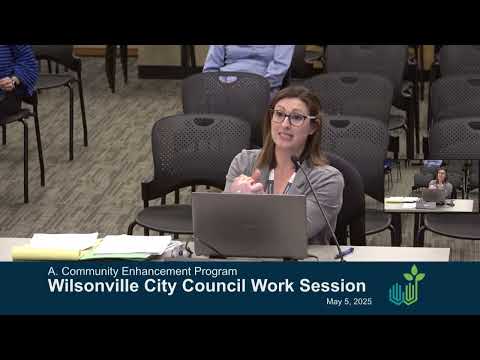
The Wilsonville Community Enhancement Committee has unanimously recommended five projects for funding in the coming fiscal year, city staff told the City Council during its May 5 meeting.
The recommendation follows a competitive application round that opened in January, drew no initial applicants, was extended to March and produced six total applications, five of which were advanced to the committee for consideration. The projects recommended for council consideration include improvements at Sharpenaux Community Foundation’s French Prairie Road corners, the Natural Resources Department’s Community Wildlife Connections maintenance, Parks Department wayfinding in Memorial Park, security and site changes at Heart of the City, and relocation support for Wilsonville Community Sharing’s move to the West Station transit-oriented development site.
Why it matters: The Community Enhancement program is one of the city’s small, locally focused grant programs. It typically receives roughly $70,000–$80,000 a year from a waste-fee–linked revenue stream, with an additional community-investment portion averaging about $35,000 per year. City staff said those streams are limited and that awards cannot replace other funding sources; council action is required for any increase to a project award.
Staff liaison Zoe Mobert (assistant to the city manager and liaison to the Community Enhancement Committee) explained program basics to council: applicants must be located inside the city limits, be a local government, school, or nonprofit, meet at least one program goal, and propose a one‑year timeline with the possibility of a one‑year extension. Mobert said the timeline requirement was shortened from two years after projects began to extend beyond the original schedule.
Mobert said the program has funded dozens of projects over its history but that there are mismatches between requests and readiness. "This is a reimbursement program," she told council, describing the typical grant payment structure for nonprofits. "We work with nonprofits to make sure that they are getting reimbursed in a timely and regular manner, because they have to put a little bit of money out first." She added that unspent allocations remain available but that any additional funding over an approved ceiling requires council approval.
Committee considerations and outreach: Staff said outreach uses the city Messenger, social media and direct notices to a nonprofit list; the committee also does targeted outreach when appropriate. The committee added a new program goal this year to support arts and cultural educational programming, though staff said no applicants this cycle explicitly applied under that new goal.
Next steps and caveats: The committee’s recommendation will be placed on a future council consent agenda for formal award. Staff cautioned that the recommended amounts are ceilings and that projects must complete required permitting and demonstrate readiness. Mobert noted that two city councilors sit on the committee (Council President Carolyn Berry and Councilor Chevlin) and that Metro Councilor Rosenthal is ordinarily a committee participant but did not take part this year.
Councilors responded positively in the work session, noting the balance of projects supporting safety, wildlife education, wayfinding and nonprofit operations. One councilor asked what happens if a project spends less than its award; Mobert reiterated that the program is reimbursement-based and that remaining budget would remain available for other projects in that fiscal year only with council action.
The committee’s recommendation, staff materials and the full list of proposed projects will be presented for council action at the next regular meeting.